Get a summary of this article with your favorite AI:
Quick answer
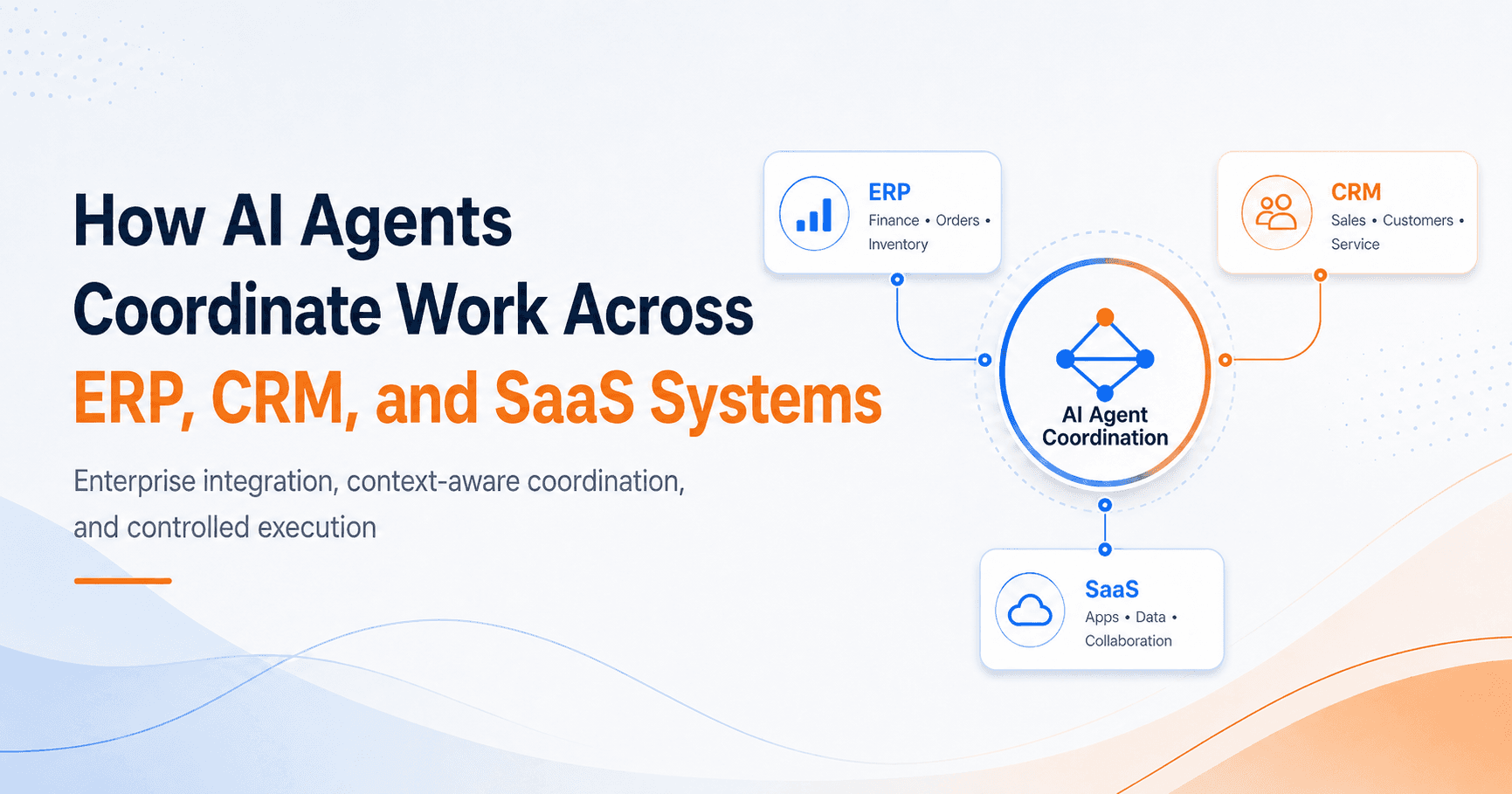
AI agents add a context-aware coordination layer across ERP, CRM, and SaaS systems. Instead of replacing APIs and traditional workflows, they work alongside them to interpret exceptions, select approved actions, and coordinate tasks across applications. The strongest enterprise architecture combines deterministic integration with controlled, agent-driven decision-making.
A sales representative updates a customer agreement in the CRM. The ERP still has the previous payment terms. A support platform knows the customer has an unresolved issue, while the billing system is ready to generate the next invoice.
None of these systems is necessarily wrong. They simply understand different parts of the same business process.
For years, enterprises have handled this problem with APIs, middleware, scheduled integrations, and rule-based workflows. Those approaches are still essential. What is changing in 2026 is the layer sitting above them.
AI agents are beginning to coordinate work that cannot always be reduced to a fixed sequence of “if this, then that” rules.
That does not mean agents are replacing APIs or integration platforms. In a well-designed enterprise architecture, the opposite is happening: APIs provide dependable access to systems, integration services enforce data and transaction rules, and agents use those capabilities to understand context, choose the next step, and handle exceptions.
The interesting question is no longer simply, “Can an AI agent call an ERP API?”
It is: How do we let an agent work across several business systems without giving it uncontrolled access to the enterprise?
Why Traditional Integration Alone Reaches a Limit
Traditional automation works extremely well when the process is predictable.
Consider a straightforward order sync:
CRM opportunity → Sales order created in ERP → Confirmation returned to CRM
The mapping can be defined in advance. Required fields are known. Validation rules are known. Failures can usually be handled through retries, alerts, or exception queues.
The difficulty appears when the process depends on context.
Suppose an order cannot be released because the customer's credit limit has been exceeded. The next action may depend on several pieces of information:
Does the account manager need to review it before finance acts?
A conventional workflow can still automate this, but every variation has to be anticipated and encoded.
As the number of systems, conditions, and exceptions grows, the workflow often becomes a large decision tree that is expensive to maintain.
This is where an agent can provide a different type of coordination.
What an Enterprise AI Agent Actually Adds
An agent should not be thought of as another API connector.
Its useful role is closer to a context-aware coordinator.
It can collect information from several approved sources, interpret the current situation, determine which predefined action is appropriate, call the necessary tools, and then evaluate the result before continuing.
A practical enterprise architecture might look like this:
Business event → Integration/orchestration layer → AI agent → Approved tools/APIs → ERP, CRM and SaaS applications
The distinction between these components matters.
APIs Still Perform the Transactions
If a customer record must be updated in Salesforce, an invoice created in an ERP, or a ticket changed in a service-management platform, an API remains the dependable mechanism for performing that transaction.
The agent should not bypass application contracts.
APIs still provide:
Defined request and response structures
Authentication and authorization
Application-level validation
Predictable transaction behavior
Error responses
Versioned interfaces.
The agent determines what needs to happen. The API determines how the target system accepts that action.
Schema transformation, data validation, retries, rate limiting, duplicate prevention, routing, authentication, logging and error handling should normally remain deterministic.
For example, if an agent decides that a validated order should be created in the ERP, the integration layer can still be responsible for transforming the agreed data object into the ERP's required payload.
This separation prevents the language model from becoming responsible for tasks that conventional software already handles more reliably.
A Practical Example: Handling a Sales Order Exception
Consider an order that arrives from a CRM and cannot immediately be released by the ERP.
A useful agent-driven process might work like this.
Step 1: A Business Event Starts the Process
The CRM sends an event when the order reaches the appropriate stage.
A conventional integration service receives it, validates the message and retrieves the required customer and order identifiers.
Step 2: The Agent Collects Relevant Context
Instead of copying every field from every system into a prompt, the agent requests only the information needed for the current decision.
It may retrieve:
Customer details from the CRM
credit status and receivables from the ERP
open support escalations from the service platform
An approval policy from an internal knowledge source.
At this point, the agent has a business context rather than a single application record.
Step 3: The Agent Determines the Next Approved Action
Perhaps the order is only slightly above the customer's credit threshold and an existing finance approval covers the amount.
The agent can identify that the order meets the organization's predefined exception policy.
If the exception is outside policy, it should not improvise. It can route the case to a person with the relevant facts attached.
Step 4: A Deterministic Service Executes the Change
Once the next action has been selected, an integration service performs the actual write operation against the ERP API.
It can validate required fields, enforce authorization, prevent duplicate processing and capture the API response.
Step 5: Other Systems Receive the Outcome
The CRM can be updated with the order status, the account owner notified, and an audit record stored.
The agent has coordinated the process, but the underlying enterprise controls have remained intact.
Workflow Automation and Agent Coordination Are Not the Same
The difference between traditional workflow automation and agent coordination becomes clearer when the two approaches are compared directly.
Area
Traditional Workflow
Agent-Coordinated Workflow
Process path
Defined in advance
Can select among approved paths based on context
Input
Primarily structured data
Structured and unstructured information
Decision logic
Rules and conditions
Rules plus contextual reasoning
Exceptions
Usually separate branches
Can investigate and classify exceptions
System access
APIs/connectors
APIs/connectors exposed as controlled tools
Reliability
Highly predictable
Requires additional evaluation and safeguards
Best use
Repetitive, deterministic transactions
Context-heavy, variable or exception-driven work
Human involvement
Usually predefined approval steps
Can escalate when confidence, policy or risk requires it
The important point is not that one approach is better.
Most useful enterprise processes will contain both.
A tax calculation should remain deterministic. Interpreting why an invoice has been rejected and determining which team should handle the exception may be suitable for an agent.
The Emerging Protocol Layer: MCP and A2A
One of the more important changes in the agent ecosystem is that developers are beginning to standardize how agents connect to tools and to one another.
MCP Standardizes Agent-to-Tool Access
The Model Context Protocol, or MCP, defines a standard way for AI applications to connect to external data sources, tools and workflows. Its current documentation describes MCP as an open-source standard for connecting AI applications with external systems.
For enterprise developers, the architectural idea is significant.
Instead of writing custom model-specific integration logic for every tool, an organization can expose approved capabilities through a more consistent interface.
An ERP-facing tool might expose operations such as:
Retrieve sales order
Check inventory
Find outstanding invoices
Create purchase request.
The agent receives capabilities rather than unrestricted database access.
That is a much healthier boundary.
A2A Addresses Agent-to-Agent Collaboration
The Agent2Agent, or A2A, protocol addresses another problem: communication between independent agents.
The current A2A specification describes it as an open standard allowing agents built on different frameworks or platforms to communicate and collaborate. It also makes an important architectural distinction: MCP focuses on agent-to-tool communication, while A2A focuses on agent-to-agent communication.
This becomes relevant when enterprises move beyond one general-purpose agent.
A procurement agent might coordinate with an inventory agent. A finance agent might validate a payment exception. A customer-service agent might contribute information about an active escalation.
Each agent can remain specialized while sharing tasks and results through an interoperable mechanism.
The A2A project is now under Linux Foundation governance, another sign that agent interoperability is moving toward an ecosystem concern rather than remaining a feature of one vendor or framework.
The Hard Part Is Not Giving Agents More Access
One of the easiest mistakes in an enterprise agent project is to measure progress by the number of systems the agent can access.
That is the wrong metric.
The goal should be to give the agent the minimum capability required to complete a defined business responsibility.
An agent that only needs to read invoice status should not receive the ability to create suppliers. An agent that prepares purchase requests should not automatically receive authority to approve them.
This is especially important because tool-enabled agents introduce a larger security surface than a simple chatbot.
MCP's own security guidance covers risks such as improper authorization, token passthrough, session attacks and overly broad access. It specifically warns against passing tokens through without properly validating that they were issued for the intended service.
Useful Controls for Enterprise Agents
A production implementation should normally include:
Least-privilege access. Give each tool and agent only the scopes it genuinely requires.
Human approval for high-impact actions. Payments, vendor creation, pricing changes, credit overrides and similar actions deserve stronger controls than read-only queries.
Deterministic validation before writes. Do not rely on the agent to decide whether an API payload satisfies every business rule.
Idempotency and duplicate protection. A retried agent run should not accidentally create the same order or payment twice.
Complete audit trails. Record the request, tools called, relevant decisions, API responses and final outcome.
Clear failure paths. When a system is unavailable or confidence is insufficient, the agent needs a defined way to stop or escalate.
Modern agent frameworks are increasingly treating guardrails, orchestration, state and human review as first-class runtime concerns rather than optional extras. OpenAI's current Agents SDK documentation, for example, separates orchestration, guardrails, state, tools and observability into explicit components of agent application design.
NIST's AI Risk Management Framework also reinforces the broader principle that trustworthiness and risk management should be considered throughout the design, development, deployment and evaluation of AI systems not added only after an application reaches production.
Where Agents Make the Most Sense
Not every integration needs an agent.
If two systems simply need to synchronize a product price, a conventional integration is usually simpler, cheaper and easier to test.
Agents become more useful when at least one of these conditions exists
Information must be gathered from several systems before an action can be chosen
Inputs include emails, documents, notes or other unstructured content
The process contains many legitimate exceptions;
Users currently spend time investigating cases before deciding what to do
The next step depends on business context rather than one field
Several specialized systems or agents need to cooperate.
A good design principle is simple:
Automate the predictable parts with software. Use agents for the parts that genuinely require interpretation.
That boundary can save a team from turning every integration project into an AI project.
A Better Way to Design Enterprise Agent Workflows
Teams building their first cross-system agent often start with the model. A stronger approach is to start with the business process.
Map the process first.
Identify the systems of record. Determine which actions are deterministic, which decisions require context, which actions are reversible, and which require approval.
Then define the tools.
Instead of telling an agent, “You can access the ERP,” give it narrow capabilities such as “GetCustomerBalance” or “CreateDraftOrder.”
After that, decide where reasoning is useful.
The result is an architecture in which the agent operates inside clearly defined boundaries rather than becoming the boundary itself.
Conclusion
AI agents are changing enterprise integration, but probably not in the way the early hype suggested.
ERP, CRM and SaaS applications are not going away. Neither are APIs, integration platforms, workflow engines or business rules.
What is changing is the coordination layer.
Agents can sit above reliable integration services, gather context from multiple systems, handle ambiguity, choose among approved actions and involve people when a process falls outside normal rules.
That combination is more useful than trying to make every process autonomous.
The enterprise architecture that is emerging is not agents instead of integrations.
It is agents working through well-designed integrations.
And for teams building these systems in 2026, that distinction may be the difference between an impressive prototype and an automation architecture that can actually survive production.
.jpeg&w=3840&q=75)