
Get a summary of this article with your favorite AI:
Most founders don't fail because they built the wrong product. They fail because they scaled the right product at the wrong time. Nobody warns you about that part. Scaling isn't a reward for having built something good. It's a separate decision, with its own risks, and it can kill a company that would otherwise have made it.
This isn't a pep talk about "10x thinking" or "growth mindset." I've watched too many founders chase that language straight into trouble. What follows is a practical look at what the data actually says about scaling: when it works, when it wrecks companies, and what to check before you commit real money and headcount to growth.
What does "scaling" actually mean, versus just growing?
Growth is adding more revenue or customers. Scaling is adding revenue faster than you're adding cost, complexity, and risk. A company that doubles its customer base by doubling its support team isn't scaling. It's just getting bigger at the same ratio. Real scaling means your systems, team structure, and unit economics can absorb two or five times the demand without breaking or bleeding cash.
This distinction matters because founders reach for scaling behaviors, like hiring ahead of demand, expanding into new markets, or raising a bigger round, when what they actually needed was to fix the ratio first. I get why. Hiring feels like progress. Fixing a broken ratio feels like standing still, even when it isn't.
How do you know if your business is actually ready to scale?
You're ready when demand is outrunning your current capacity to serve it without proportional increases in cost or founder time. Not when you feel behind. Not when a competitor raises a round and you feel pressure to match it.
The most detailed research on this comes from the Startup Genome Project, which studied more than 3,200 high-growth technology startups. It found that roughly 70% of these companies scaled prematurely along at least one dimension: customers, product, team, business model, or funding, before that dimension was actually validated. The project classified startups that scaled too early as "inconsistent" and those that scaled in the right order as "consistent." Companies that got the order right grew roughly 20 times faster than the ones that jumped ahead of themselves.
Signs you're not actually ready, even if the top-line numbers look fine:
You're spending more to acquire each new customer than you did six months ago, and margins are shrinking instead of improving
Founders are still personally closing every deal or fixing every support ticket. The business hasn't been taught to run without you in the room
You've added headcount to keep pace with demand, but revenue per employee is flat or falling
Retention looks solid for your first 50 to 100 customers, but you haven't tested it beyond that group
None of these are fatal on their own. They're signals that the system isn't ready yet, even when the idea clearly is.
What's the real cost of scaling too early?
The most common outcome isn't a dramatic collapse. It's a slow bleed that eventually looks like a cash problem, even though the cash problem was never the root cause.
CB Insights recently analyzed 431 venture-backed startups that shut down since 2023. "Ran out of capital" was cited in roughly 70% of these failures, but CB Insights is explicit that this is the final event, not the root cause. When they dug into what actually broke first, poor product-market fit showed up in about 43% of cases, bad timing in about 29%, and unsustainable unit economics in about 19%. (Those numbers add up to more than 100% because most failures had more than one contributing cause. A company can have weak product-market fit and bad unit economics at the same time. Most do.)
Startup Genome's research adds a downstream number worth sitting with: 93% of startups that scaled prematurely never broke the $100,000-a-month revenue threshold. Scaling too early doesn't just slow you down. For most companies it happens to, it caps them permanently below a level most people would call a real business.
If you're running a new initiative inside an established company rather than a venture-backed startup, the mechanism is identical even if the stakes look different. A new product line or market that gets resourced before it's validated quietly drains budget and management attention from whatever's already working.
Does raising more money mean you're ready to scale?
No. Treating a big raise as a readiness signal is one of the more expensive mistakes founders make. Capital extends your runway to figure things out. It doesn't fix a broken model, and it can speed up how fast a broken model burns through cash. In the CB Insights dataset above, the 431 failed companies had raised a combined $17.5 billion before shutting down, with a median of $11 million raised per company. Money didn't save them, because the underlying problem was never a lack of capital.
A more useful readiness question than "how much have we raised" is this: if we couldn't raise another dollar, would our current unit economics let us survive on what we're generating today? If the honest answer is no, more funding buys time. It doesn't buy readiness.
Should you hire and build systems ahead of demand, or wait?
Wait, with one real exception: the manual, unscalable work you do before scaling is what earns you the right to scale later. This is the part founders get backwards most often. They assume scaling means building repeatable, automated systems from day one. The founders behind some of the most-cited scaling successes did the opposite early on.
Y Combinator co-founder Paul Graham's 2013 essay, "Do Things That Don't Scale," documents this directly. Early Airbnb founders personally visited hosts in New York to photograph listings and improve them by hand. That obviously wouldn't work once the company had millions of listings, but it taught them exactly what made a listing convert. Stripe's founders did something similar. When an early user agreed to try the product, the founders would set it up on that person's laptop in person, on the spot, a technique YC came to call the "Collison installation," rather than sending a signup link and hoping for the best.
The lesson isn't "stay small forever." It's that the manual, in-person, doesn't-scale work is how you learn what's actually worth automating. Systems and hires built before that learning happens tend to formalize guesses, not validated processes. That's the exact premature-scaling pattern Startup Genome's data flags as the top predictor of failure.
How fast should a company actually grow to survive long-term?
Fast, but not indiscriminately, and "fast" needs to be scoped honestly. McKinsey's "Grow Fast or Die Slow" research tracked more than 3,000 public software and online-services companies and found that only about 3% ever reach $1 billion in annual revenue. Look further out and it gets starker: of 3,197 public software companies launched between 1980 and 2013, only 19, under 1%, ever reached $4 billion in annual revenue. The same research found that "supergrowers," companies compounding revenue at more than 50% a year, were roughly eight times more likely to reach the $1 billion mark than companies growing under 20% annually.
Here's the trap: applying that stat to a business that hasn't earned the right to grow that fast yet. McKinsey's research is about software companies that had already found product-market fit and were choosing how aggressively to reinvest. It's not a mandate to force 50% growth onto a business still working out who its customer is. Put next to the Startup Genome and CB Insights numbers above, the fuller picture is simple to state and hard to live by: validate first, then grow as fast as your unit economics and systems can genuinely support. Slow, unfocused growth and fast, premature growth fail for related but different reasons.
What should founders check before committing to a scaling push?
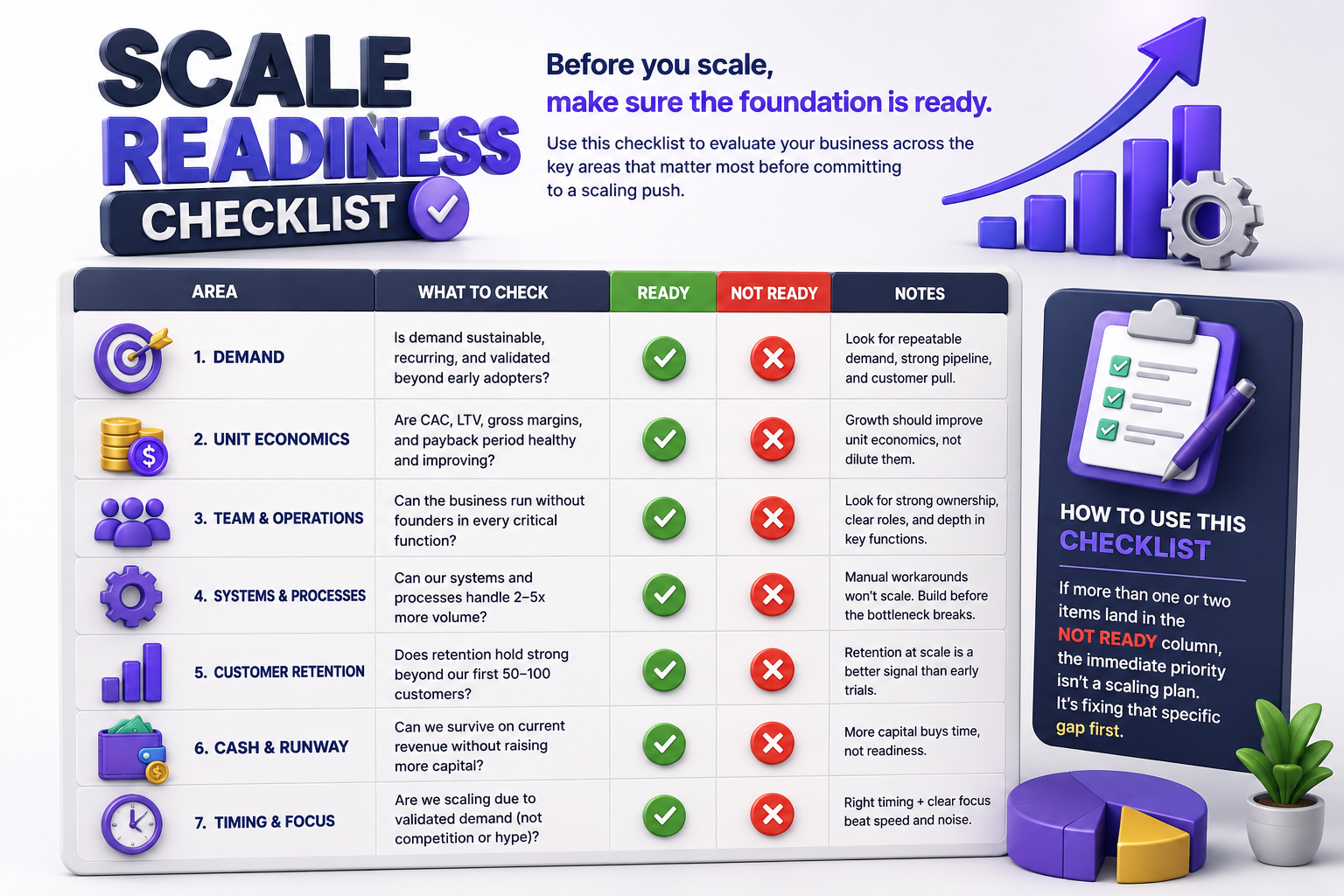
If more than one or two rows land in the "not ready" column, the immediate priority isn't a scaling plan. It's fixing that specific gap first.
Where founders get this wrong even when they know the data
Here's the uncomfortable part, worth saying plainly instead of softening it: knowing this data doesn't stop founders from ignoring it. There's a pattern I keep running into in founder circles: everyone can quote the Startup Genome stat that roughly 70% of startups scale prematurely, and everyone still plans to double or triple headcount this year anyway, usually justified with some version of "the market moves fast" rather than actual validated demand. The data and the behavior contradict each other constantly, because scaling feels like progress in a way that slow validation work doesn't. Writing code, signing leases, posting job listings. All of it feels like forward motion. Sitting with a small, unscaled process long enough to actually learn from it feels like standing still. It isn't. It's the only part of the job that tells you what to build next.
FAQ
How do I know if my business is ready to scale, or if I just want it to be?
Check whether demand is outpacing your capacity without proportional cost increases, not whether you feel ready or pressured by competitors. If CAC is rising and margin per customer is flat, you're not ready yet, regardless of what the top-line numbers say.
Is it a mistake to hire ahead of demand when scaling?
Generally yes, unless a specific role is the proven bottleneck to serving already-validated demand. Startup Genome's research lists "hiring too many people too early" as one of the recurring premature-scaling patterns among the startups it studied.
Does raising a large funding round mean we're ready to scale?
No. Capital extends runway; it doesn't fix a broken model. CB Insights' data on failed venture-backed startups shows companies that raised tens of millions still failed for the same product-market-fit and unit-economics reasons as bootstrapped companies.
What's the difference between growing and scaling?
Growth is adding revenue or customers. Scaling is adding revenue faster than cost and complexity grow. A team that doubles headcount to double revenue is growing, not scaling.
Should we automate our processes before we scale, or after we've grown?
After you've done the manual version enough to know what's actually worth automating. Paul Graham's research on early-stage companies found that founders who did unscalable, manual work first, recruiting users one by one, delivering service by hand, learned what to build before they built it.
How fast does a company need to grow to survive?
Fast growth strongly correlates with reaching major revenue milestones, but McKinsey's research applies to companies that have already found product-market fit. Forcing aggressive growth onto an unvalidated business tends to produce the premature-scaling failure pattern, not the supergrower pattern.
What's the single biggest mistake founders make when scaling?
Treating "ran out of cash" as the root problem. CB Insights' analysis of failed startups found capital running out is almost always the final event, not the cause. The more common root issues are poor product-market fit, bad timing, and unsustainable unit economics.
Is there a safe way to test readiness before committing fully to a scaling push?
Yes. Scale one dimension at a time, geography or one new channel, for example, and hold everything else constant. That way you can isolate whether the gap is demand, delivery capacity, or economics before committing headcount and budget across the board.
A note on scope: this covers venture-style tech scaling and the general principles that carry over to any growing business. If you're scaling a services business, a bootstrapped company, or a non-software product, the unit-economics and premature-scaling logic still applies. The specific growth-rate benchmarks from McKinsey's research are specific to software and online-services companies and shouldn't be applied outside that context without adjustment.
Sources
CB Insights: Why Startups Fail, Top 9 Reasons
Startup Genome: Premature Scaling, A Deep Dive
Startup Genome Report Extra: Premature Scaling (original 2011 report)
McKinsey: Grow Fast or Die Slow, Pivoting Beyond the Core
Paul Graham: Do Things That Don't Scale (2013)
.jpeg&w=3840&q=75)