Get a summary of this article with your favorite AI:
Quick answer
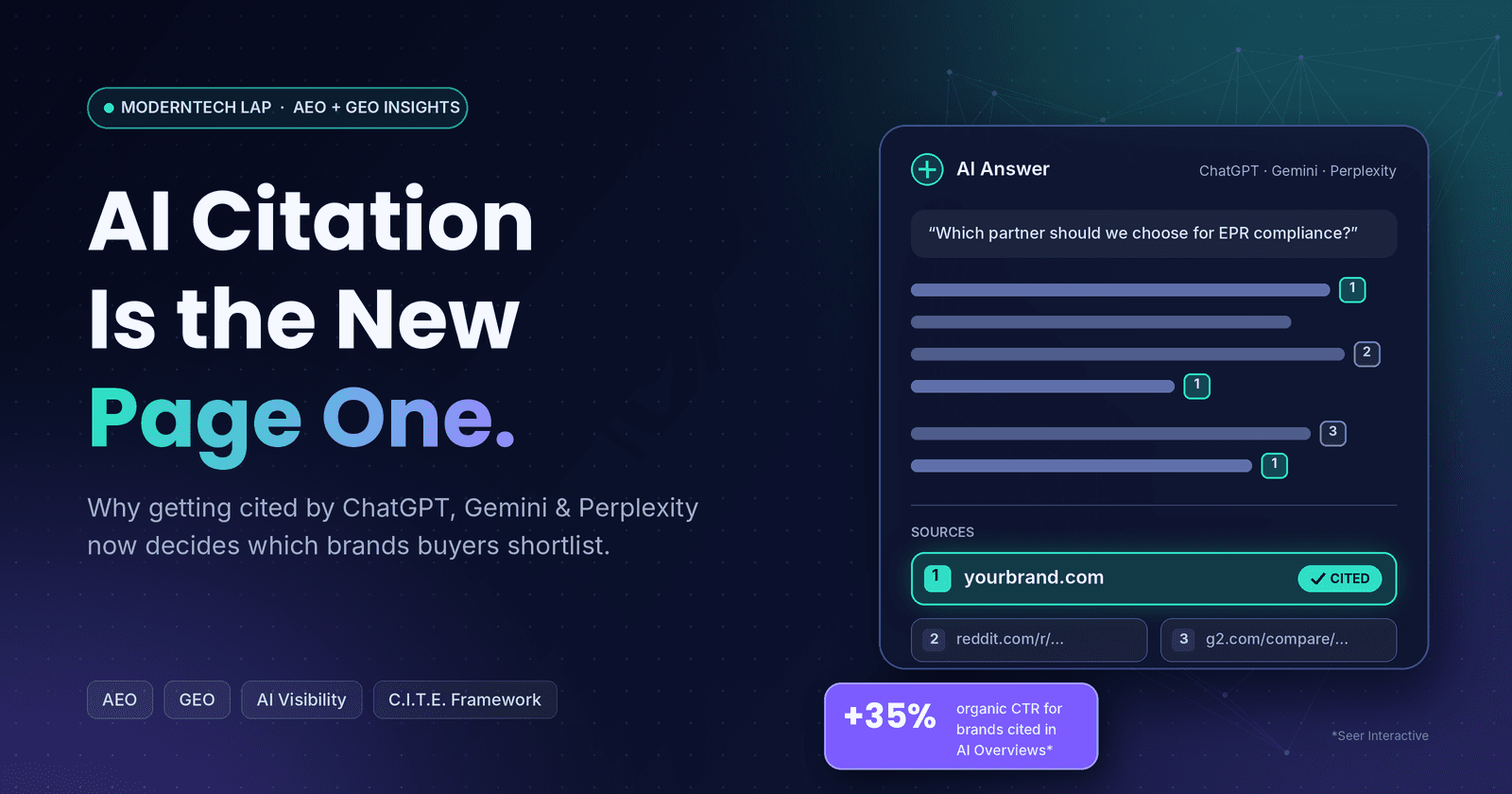
AI citation is when ChatGPT, Gemini, Perplexity or Google AI Overviews name or link your page as a source. It now works like a first-page ranking: AI Overviews are linked to 58% fewer clicks on the top result, while cited brands see 35% higher organic CTR. Earn citations by making pages crawlable, extractable, corroborated and evidence-backed.
• An AI citation is a link or named source an AI answer engine shows as evidence for its answer. It is now the closest thing AI search has to a first-page ranking.
• The audience is huge. ChatGPT reports 1.2 billion weekly users, Google’s AI Overviews reach 2.5 billion monthly users and AI Mode passed 1 billion monthly users in 2026.
• Clicks are shrinking, but citations pay. Ahrefs links AI Overviews to a 58% lower click-through rate for the top result. Seer Interactive found brands cited inside AI Overviews earn 35% more organic clicks than brands that are not cited.
• Ranking is no longer a proxy for being cited. Only about 38% of pages cited in Google’s AI Overviews also rank in the top 10 for that query.
• Off-site reputation beats backlinks. In Ahrefs’ 75,000-brand study, brand mentions and YouTube mentions correlated with AI visibility far more strongly than backlinks did.
• AEO makes you the extractable answer. GEO makes you the trusted entity. You need both to be cited. The C.I.T.E. framework below covers both.
Quick answer: What is AI citation, and why does it matter? AI citation is when an AI answer engine such as ChatGPT, Gemini, Perplexity or Google AI Overviews names or links your page as a source for its answer. It matters because buyers increasingly decide from the answer itself, without clicking through, so the sources the AI cites become the brands buyers shortlist.
1. The shift: from being ranked to being referenced
For twenty years, digital visibility had one unit of measure: the ranking. You were position 1, position 4 or page 3. AI search has replaced that unit. When a founder asks ChatGPT “Which reverse logistics partners in India handle EPR compliance?”, there is no page 3. There is one synthesized answer, and a short list of sources behind it.
The scale makes this impossible to ignore:
• At DevDay 2026 in September, OpenAI described ChatGPT as reaching 1.2 billion weekly users.
• India alone accounts for 100 million weekly ChatGPT users, the platform’s second-largest market after the US (Sam Altman, February 2026).
• At I/O 2026, Google said AI Overviews reach 2.5 billion monthly users and AI Mode crossed 1 billion monthly users within a year of launch. The average AI Mode query is about three times longer than a traditional search.
Longer queries are conversations, not keywords. A conversation ends in a recommendation, and the AI supports that recommendation with citations.
The new rule: if you are not cited, you were not considered.
2. Mention, citation, recommendation: three outcomes most teams confuse
Most “AI visibility” reports blur three different events. They have different causes and need different fixes.
Outcome | What it looks like in an AI answer | What drives it | Business value |
Mention | Your brand name appears in the answer text | Off-site reputation, training data, how often the web talks about you | Awareness |
Citation | Your URL appears as a source link or footnote | Retrievable, extractable, trustworthy pages that answer the sub-question | Authority + a click path |
Recommendation | The AI tells the user to choose you | Consistent third-party agreement, reviews, comparisons, clear fit | Pipeline |
Two niche concepts are worth naming here, because most audits miss them:
The Citation Gap. You are mentioned in the answer, but someone else is cited for the claim about you, often a Reddit thread, a G2 page, a listicle or a competitor’s comparison post. In that case, the AI describes your brand in someone else’s words. A citation gap is a narrative-control problem, not a visibility problem.
The Borrowed Citation. Your research, data or quote is used in the answer, but the AI links to the site that republished it. You did the work; they get the authority signal. This usually happens when the original page is hard to crawl, slow, or buries the number in a PDF or an image.
3. Why AI citation matters more than the click
3.1 The click is disappearing
The evidence on zero-click behaviour is now consistent across methods:
• Ahrefs (300,000 keywords, December 2023 vs December 2025): an AI Overview on the page correlates with a 58% lower average click-through rate for the top-ranking result.
• A pre-registered randomized field experiment (January–February 2026) found AI Overviews cut organic clicks on triggered queries by 38%, and zero-click searches rose from 54% to 72%.
3.2 But being cited inside the answer recovers value
Seer Interactive found that brands cited in AI Overviews earn 35% higher organic CTR and 91% higher paid CTR than brands that are not cited. In other words, citation is the difference between being summarized away and being the source the summary sends people to.
3.3 AI visitors arrive pre-decided, and land deep
The conversion data is genuinely mixed, and I think it’s better to say so than to oversell it:
• Seer Interactive measured Perplexity visits converting at 15.9% vs 9.77% for organic search.
• Ahrefs reported that AI search drove 0.5% of its traffic but 12.1% of its signups.
• Amsive, studying 54 sites, found no statistically significant difference (4.87% vs 4.6%).
The pattern that does hold is where AI visitors land. Seer found only about 7% of AI-referred visits land on the homepage. Most land two or three levels deep, on the specific page that answered the specific question. Your deep pages are your new front doors, and they need to be built to be cited.
3.4 The real prize is the shortlist, not the session
Even when nobody clicks, the cited sources shape what the buyer believes, which vendors they shortlist and which brand they search for next. For B2B founders, AI citation is closer to analyst coverage than to SEO traffic. It is upstream of every channel you measure.
4. How AI engines actually decide what to cite
To earn citations, you need a working model of the pipeline. Simplified, most retrieval-augmented answer engines work like this:
1. Crawl. AI bots fetch pages: OpenAI’s OAI-SearchBot and ChatGPT-User, Anthropic’s Claude-SearchBot and Claude-User, PerplexityBot, and Google’s own crawler for AI Overviews and AI Mode.
2. Index. Pages go into the engine’s index or a partner search index.
3. Fan out. The engine splits the user’s question into several sub-queries. Google has confirmed AI Overviews and AI Mode use this query fan-out technique.
4. Retrieve passages, not pages. The system pulls the specific chunks that best answer each sub-query.
5. Synthesize. The model writes one answer from those chunks.
6. Attribute. It cites the sources whose passages it relied on most.
Three consequences follow, and they are the core of modern AEO/GEO:
Fan-out breaks the link between ranking and citation. Ahrefs’ study of 863,000 keywords and 4 million AI Overview URLs found only ~38% of cited pages ranked in the top 10 for the original query; about 31% did not rank in the top 100 at all. You get cited for the sub-questions you answer well, not just the head keyword you target.
Citation happens at the passage level. A 3,000-word page with one buried answer loses to a 900-word page whose answer is in a clean, self-contained paragraph.
There are two roads into an answer. The memory road (what the model learned in training, built slowly through years of mentions) mostly drives mentions. The retrieval road (what it fetches live) mostly drives citations. You can move the retrieval road in weeks, but the memory road takes quarters.
5. AEO vs GEO: where each one earns the citation
AEO and GEO are often used as synonyms. In practice they solve different halves of the citation problem.
AEO: Answer Engine Optimization | GEO: Generative Engine Optimization | |
Core question | Can the engine lift a clean answer from my page? | Does the engine trust my brand enough to use and name it? |
Unit of work | The passage, the question, the page | The entity, the brand, the web-wide footprint |
Main levers | Question-led headings, 40–80-word answer blocks, tables, FAQs, schema, server-rendered HTML | Brand mentions, third-party reviews, YouTube, Reddit, LinkedIn, original data, consistent entity facts |
Drives mostly | Citations | Mentions and recommendations |
Time to impact | Weeks | Months to quarters |
The research backs the GEO half strongly. In Ahrefs’ 75,000-brand study, YouTube mentions had the strongest correlation with AI visibility (~0.737) across ChatGPT, AI Mode and AI Overviews, and branded web mentions followed closely (0.66–0.71). For AI Overviews specifically, brand web mentions correlated at 0.664 versus 0.218 for backlinks. Correlation is not causation, but the direction is clear: AI engines weigh what the web says about you more than how many sites link to you.
The source mix matters too. Peec AI’s analysis of 30 million citations ranks Reddit, YouTube, LinkedIn, Wikipedia and Forbes among the most-cited domains. ChatGPT leans toward Wikipedia and editorial sites, Google’s AI surfaces lean toward social and review platforms, and Perplexity surfaces G2 for B2B queries.
6. The C.I.T.E. framework: ModernTech Lap’s model for earning AI citations
We use four tests at ModernTech Lap. Fail one and citations leak to a competitor.
C: Crawlable (can the bot read it?)
• Server-render critical content. Vercel’s crawler study found that none of the major AI crawlers it tracked, including OpenAI’s and Anthropic’s bots, execute JavaScript. If your pricing, specs or answers load client-side, those AI engines see an empty page. Google’s stack is the exception.
• Separate training bots from search bots in robots.txt. You can block model training (for example, GPTBot) while still allowing search and user-retrieval bots (OAI-SearchBot, ChatGPT-User, Claude-SearchBot, PerplexityBot). Many sites accidentally block both, then wonder why they never get cited.
• Know Google’s split. Google-Extended controls whether your content is used for Gemini models. It does not remove you from AI Overviews, which are governed by normal Googlebot crawling.
• Keep key facts out of images and gated PDFs. That is how Borrowed Citations happen.
I: Interpretable (can the engine extract a clean answer?)
• Write headings as the questions buyers actually ask (“How much does EPR compliance cost for a mid-size electronics brand?”).
• Put a 40–80-word, self-contained answer directly under each heading, then expand. Each answer block should still make sense if it is the only thing the AI lifts.
• Use tables for comparisons and numbered steps for processes. They chunk cleanly.
• Add Article, Organization, Person, FAQPage and Product schema so the entity, author and facts are machine-explicit, and keep them consistent with on-page text.
• One entity, one set of facts. Your founding year, headcount, locations and category description should match across your site, LinkedIn, Crunchbase, G2 and directories. Conflicting facts make AI engines hedge or skip you.
T: Trusted (does the rest of the web agree with you?)
• Earn mentions, not just links. Founder interviews, podcasts, guest research and industry roundups all build the mention footprint AI engines rely on.
• Show up on YouTube. Ahrefs reports YouTube is the most-cited domain in AI Overviews overall, and its mention count is the strongest correlate of AI visibility in its study.
• Be present where your category is discussed: Reddit threads, LinkedIn posts, G2/Clutch reviews. Participate honestly. Astroturfing gets detected and down-weighted.
• Close Citation Gaps by publishing your own definitive comparison and “alternatives to” pages, so the AI has a first-party source to cite about you.
E: Evidenced and fresh (does the page give the AI something to quote?)
• Add statistics, named sources and expert quotations. The Princeton-led GEO paper (Aggarwal et al., KDD 2024) found these methods lifted source visibility in generative engine responses by up to 40%, while keyword stuffing did not help.
• Publish original data. A unique number is the most citable asset on the web, because no one else can be cited for it.
• Refresh with substance. Ahrefs’ analysis of 17 million citations found AI assistants cite content that is 25.7% fresher than what ranks in organic results, with ChatGPT showing the strongest preference for new pages. Update the facts, then the date, never just the date.
• Show the author. Real name, role, credentials and a dated “last updated” line.
7. Anatomy of a citable passage
Here is the same paragraph, written two ways.
Not citable:
We are a leading provider of innovative reverse logistics solutions that help businesses achieve their sustainability goals with cutting-edge technology and world-class service.
Citable:
A Producer Responsibility Organisation (PRO) collects and recycles e-waste on behalf of brands so they can meet Extended Producer Responsibility (EPR) targets under India’s E-Waste (Management) Rules, 2022. Brands typically use a PRO when they lack their own collection network across states. [Company] operates as a PRO in [X] states, as of [month, year].
The second version wins because it has:
1. A definition in the first sentence (answers “what is”).
2. A named regulation (a verifiable entity).
3. A condition (answers “when do I need this”).
4. A scoped, dated, specific claim about the company (citable without hype).
Rule of thumb: if a sentence cannot be quoted on its own and still be true, useful and attributable, an AI will not cite it.
8. Measuring AI citation without fooling yourself
AI answers are probabilistic. SparkToro and Gumshoe.ai ran the same prompts repeatedly across ChatGPT, Claude and Google’s AI and found less than a 1-in-100 chance of getting the same brand list twice, and less than 1-in-1,000 of getting it in the same order. So “we’re #2 in ChatGPT” is mostly noise.
Measure share across many runs, not positions:
Metric | Definition | Why it matters |
Citation Share | % of answers across your prompt set that cite your domain | Your true “share of the shortlist” |
Mention Rate | % of answers that name your brand, linked or not | Reputation and memory-road strength |
Citation Gap | Answers that mention you but cite a third party for it | Who controls your narrative |
Source Mix | Which domains get cited in your category (Reddit, G2, YouTube, competitors) | Tells you where to earn presence |
Answer Accuracy | % of answers that describe you correctly (pricing, location, category) | Wrong answers cost deals silently |
How to build a reliable prompt set:
• Write 30–100 prompts mapped to the buyer journey: problem-aware (“why are my returns costs rising”), solution-aware (“best reverse logistics software India”), vendor-aware (“[You] vs [Competitor]”).
• Run each prompt multiple times per engine, across ChatGPT, Gemini/AI Mode, Perplexity, Copilot and Claude.
• Track monthly trends, not single snapshots.
• Tag AI referrals in analytics (chatgpt.com, perplexity.ai, gemini.google.com, copilot.microsoft.com, claude.ai) and watch which deep pages they land on.
9. Five myths that waste AEO/GEO budgets
1. “llms.txt will get us cited.” Ahrefs found 97% of llms.txt files received zero requests in May 2026, and Google’s own guidance says such files are not needed to appear in its AI features. It may help coding agents read documentation. It is not a citation strategy.
2. “Rank #1 and the citation follows.” It no longer does reliably. Roughly 62% of AI Overview citations come from pages outside the top 10.
3. “More keywords, more visibility.” The GEO research found keyword stuffing does not improve generative visibility. Evidence does.
4. “Block every AI bot to protect our content.” Blocking search and retrieval bots removes you from the answers your buyers read. Decide training and retrieval separately.
5. “Track our AI ranking position.” Positions inside AI answers are too volatile to mean much. Track citation share over many runs.
10. A 30-day AI citation sprint
Week 1: Baseline. Build a 50-prompt set across the buyer journey. Run it on five engines, several times each. Record Citation Share, Mention Rate, Citation Gaps, Source Mix and Answer Accuracy.
Week 2: Crawlability. Audit robots.txt for training vs retrieval bots. Fetch your top 20 pages with JavaScript disabled. Move critical facts out of images and PDFs. Fix entity inconsistencies across your site, LinkedIn and directories.
Week 3: Extractability. Rewrite your top 10 commercial and informational pages with question headings, 40–80-word answer blocks, comparison tables, FAQs, schema and a named author with a dated update line.
Week 4: Corroboration. Publish one original data point. Pitch it to three industry publications. Record one YouTube explainer. Answer real questions in two relevant Reddit or LinkedIn communities. Then re-run the prompt set and compare against Week 1.
Repeat monthly. Citation share compounds: every credible mention makes the next citation more likely.
11. Frequently asked questions
What is an AI citation? An AI citation is a source that an AI answer engine (ChatGPT, Gemini, Perplexity, Copilot, Claude or Google AI Overviews) links to or names as evidence for its answer. It is the AI-search equivalent of a first-page ranking.
What is the difference between AEO and GEO? AEO (Answer Engine Optimization) structures your content so an engine can extract a clean answer from your page. GEO (Generative Engine Optimization) builds the off-site reputation and evidence that make generative engines trust, mention and recommend your brand. AEO mainly earns citations; GEO mainly earns mentions and recommendations.
Does ranking on Google still matter for AI citations? Yes, but less directly. Ahrefs found only about 38% of pages cited in AI Overviews rank in the top 10 for the original query, because Google fans the query out into sub-questions and cites the best answers to those.
How do I know if ChatGPT or Perplexity cites my website? Run a fixed set of buyer-journey prompts several times on each engine and record how often your domain appears as a source. Also check analytics for referral traffic from chatgpt.com, perplexity.ai, gemini.google.com and copilot.microsoft.com. Because AI answers vary from run to run, measure citation share over many runs, not a single result.
Does llms.txt help AI citations? Current evidence says no. Ahrefs found 97% of llms.txt files received no requests in May 2026, and Google says such files are not needed for its AI features.
How long does it take to get cited by AI engines? Fixes to crawlability and on-page extractability can show up in retrieval-based answers within weeks. Building the brand mentions and reputation that drive recommendations usually takes several months.
Should I block GPTBot and other AI crawlers? Treat training and retrieval separately. You can block training crawlers such as GPTBot while allowing search and user-retrieval bots such as OAI-SearchBot, ChatGPT-User, Claude-SearchBot and PerplexityBot. Blocking retrieval bots removes you from the answers your buyers read.
Key takeaway
Search used to reward the best-ranked page. AI search rewards the most citable, most corroborated source. The brands that win the next three years will treat every important page as a set of quotable answers, and every mention across the web as a vote the AI can count.
Want to see where your brand stands? ModernTech Lap’s AI Visibility Engine measures your Citation Share, Citation Gaps and Source Mix across ChatGPT, Gemini, Perplexity and Google AI Overviews.