
Get a summary of this article with your favorite AI:
A practical guide for property management executives on automation, adoption, and implementation
Property management has always been a business of thin margins and thick workloads. A typical firm juggles rent collection, maintenance coordination, tenant communication, lease renewals, vendor management, owner reporting, and regulatory compliance — often across hundreds or thousands of units, and often with software stacks that were designed a decade ago. For most of the industry's history, the only way to grow was to hire more people, and the only way to protect margins was to squeeze more work out of the people already on staff.
Artificial intelligence is breaking that equation. For the first time, property management firms can grow their portfolios substantially faster than their headcount, respond to tenants around the clock without staffing a night shift, and predict maintenance failures before a resident ever files a ticket. The shift is not hypothetical or distant. Industry surveys show AI adoption among property managers surging — Buildium's 2026 industry report found adoption jumping from roughly 20% to 58% of firms in a single year — and the operational gap between adopters and non-adopters is already showing up in growth projections: firms with broad AI adoption project roughly 31% portfolio growth in 2026, versus about 12% for firms that have not adopted.
Yet the technology is only half the story. AI implemented carelessly can fragment your data, frustrate your tenants, and even expose your firm to fair housing liability. This article looks at three questions every property management executive should be asking: how exactly is AI changing the industry, which processes can genuinely be automated today, and what does a disciplined, low-risk implementation actually look like?
The Inflection Point: Why AI Matters to Property Management Now
Property management is unusually well suited to AI for a simple reason: an enormous share of the daily work is repetitive, rule-based, and communication-heavy. Answering the same forty leasing questions, chasing the same late payments, triaging the same categories of maintenance requests, assembling the same monthly owner statements — these are precisely the tasks that modern AI systems handle well. Morgan Stanley has estimated that roughly 37% of real estate tasks are automatable, representing as much as $34 billion in potential efficiency gains for the sector by 2030.
At the same time, the economics of the business are tightening. Labor costs continue to rise, experienced property managers are hard to hire and harder to retain, and both owners and tenants now expect the kind of instant, always-on service they get from consumer apps. In recent industry surveys, adopting new technology ranks as the top tactic firms plan to use to respond to elevated costs and rising customer expectations. The pressure is coming from both sides: costs push firms toward automation, and customer expectations pull them toward it.
The vendor landscape has matured to meet that demand. This is no longer just a market of standalone chatbots. Major platforms are shipping deeply embedded AI: Entrata has announced an agentic property management system with more than one hundred embedded AI agents spanning leasing, maintenance, accounting, payments, and resident operations, and RealPage's Lumina positions itself as a coordinated 'AI workforce' across leasing, finance, and resident engagement. When the core platforms your firm already runs on are embedding AI at this depth, the question stops being whether to adopt and becomes how quickly and how carefully.
The results reported by early adopters explain the urgency. Operators using AI report meaningful reductions in operating expenses — one industry survey found 77% of AI-using operators reporting moderate to significant OpEx reductions — and 85% report measurable improvements in lead-to-lease conversion. One multifamily operator that implemented an AI leasing and support assistant saw inquiry response times fall by more than 60% while tenant satisfaction scores rose. These are not marginal gains; they are the kind of numbers that change what a firm's cost structure and growth ceiling look like.
Where AI Is Changing the Business: The Major Use Cases
Leasing and Prospect Management
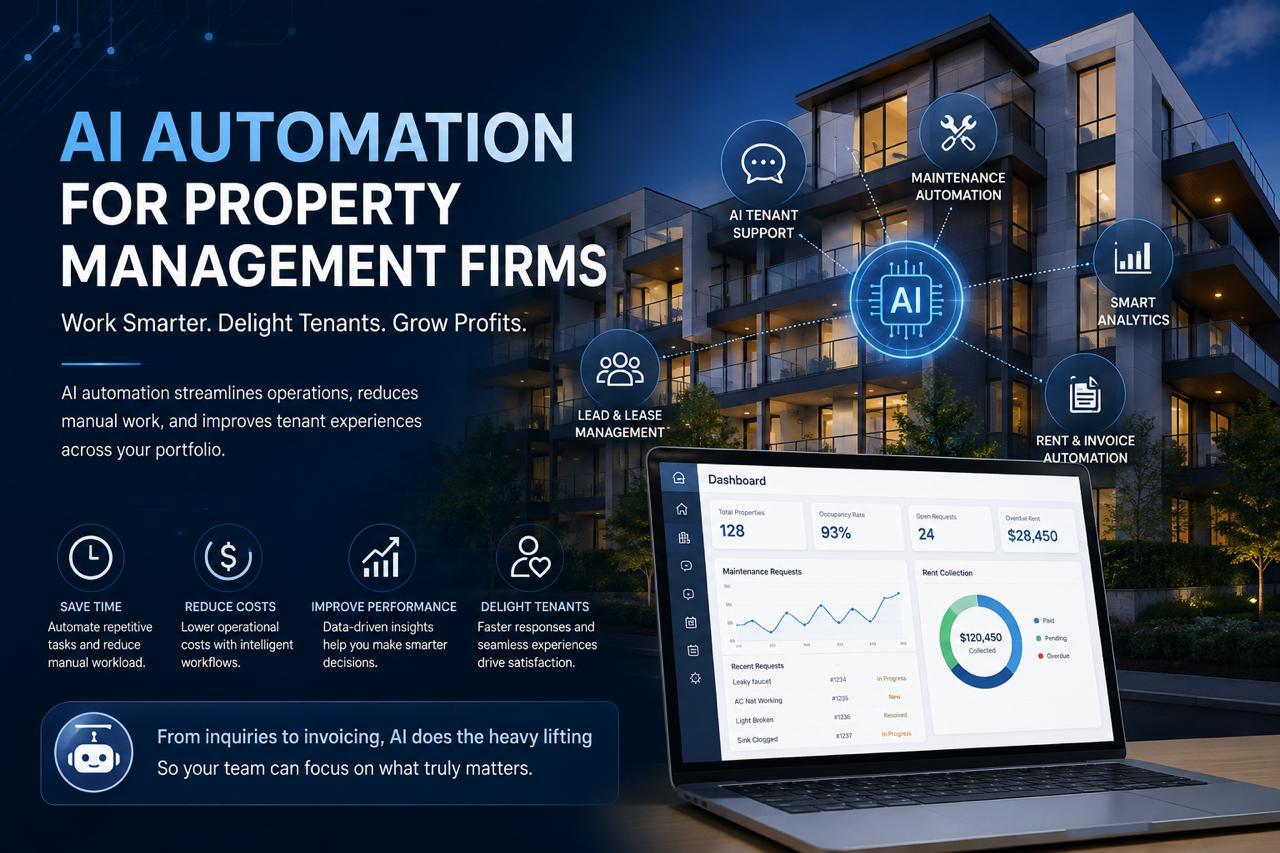
Leasing is where AI delivers the fastest, most visible wins. The classic failure mode in leasing is speed: a prospect inquires at 9 p.m. on a Saturday, nobody responds until Monday afternoon, and by then the prospect has toured a competitor's unit. AI leasing assistants eliminate that gap entirely. They answer availability and pricing questions instantly at any hour, qualify prospects against your criteria, schedule tours directly into your team's calendars, and follow up automatically with prospects who have gone quiet.
The economics are compelling because leasing inquiries are high-volume and highly repetitive. The overwhelming majority of prospect questions — availability, pet policy, parking, application requirements, move-in costs — can be answered from your existing listing and policy data. Firms that deploy AI here typically find their human leasing agents spend far less time on repetitive inquiry-handling and far more time on tours and closing, which is exactly where human skill actually moves the needle.
Tenant Communication and Service
Beyond leasing, AI assistants are increasingly handling the day-to-day flood of resident communication: questions about lease terms, payment confirmations, amenity bookings, package inquiries, and community policies. A well-implemented assistant resolves the routine majority instantly and escalates the genuinely complex or sensitive cases to staff with full context attached. Residents get faster answers; staff get fewer interruptions; and the firm gets a searchable record of every interaction.
The subtler benefit is consistency. Human teams answer the same question differently depending on who picks up the phone and how their day is going. An AI assistant grounded in your actual policies gives the same correct answer every time — which reduces disputes, reduces liability, and improves the resident experience in ways that show up in renewal rates.
Maintenance: From Reactive to Predictive
Maintenance is typically the largest controllable expense in property management, and AI attacks it from two directions. The first is intelligent triage. When a resident reports an issue, AI can interview them conversationally — what exactly is happening, since when, which fixture, is water actively leaking — diagnose the likely problem, assess urgency, and route a properly detailed work order to the right technician or vendor. That single step eliminates an enormous amount of back-and-forth, misdiagnosed dispatches, and second truck rolls.
The second direction is prediction. AI systems can analyze equipment age, service history, sensor data, and portfolio-wide failure patterns to flag assets likely to fail before they do. Replacing a water heater on your schedule costs a service call; replacing it after it floods a unit costs remediation, displacement, an insurance claim, and an angry resident. Predictive maintenance converts emergencies into planned work, and planned work is always cheaper.
Rent Collection and Revenue Management
On the revenue side, AI is automating both collection mechanics and pricing intelligence. Automated systems handle payment reminders, receipt confirmation, late-payment escalation sequences, and payment-plan workflows without a staff member touching each account. Meanwhile, pricing algorithms analyze historical performance, local market comparables, seasonality, and demand signals to recommend rents that balance occupancy against income — replacing gut-feel pricing with evidence, particularly valuable for firms managing scattered portfolios across multiple submarkets.
A note of caution belongs here, however: algorithmic rent-setting has drawn regulatory and legal scrutiny, particularly where shared pricing algorithms use non-public competitor data. Firms should use pricing tools that rely on public market data and their own portfolio data, and treat algorithmic recommendations as inputs to human decisions rather than automatic actions.
Accounting, Reporting, and Back Office
The back office is the least glamorous and often the highest-value target. AI now automates invoice ingestion and coding, bank reconciliation matching, delinquency reporting, budget variance flagging, and the assembly of monthly owner statements. For firms whose accounting teams spend the first two weeks of every month producing reports, automation here directly expands capacity — the same team can support a substantially larger portfolio. Owner-facing reporting also improves qualitatively: instead of a static PDF, AI can generate plain-language narrative summaries of each property's performance, which owners consistently rate as more valuable than raw statements.
Tenant Screening and Document Processing
AI accelerates application processing by extracting and verifying information from pay stubs, IDs, and bank statements, flagging inconsistencies and potential fraud — a growing problem as fraudulent application documents have become easy to fabricate. Used carefully, this both speeds up approvals for legitimate applicants and strengthens the firm's defense against income and identity fraud. Screening is also the single most legally sensitive AI application in the industry, a point covered in depth below.
How to Implement AI the Right Way: A Playbook for Firms
The difference between firms that get transformative results from AI and firms that get an expensive mess is rarely the technology they buy. It is the discipline of the implementation. The following playbook reflects what consistently separates successful adopters from the rest.
1. Start with Your Pain, Not with the Technology
The most common failure pattern is buying an AI tool because it is impressive, then hunting for a problem to point it at. Successful firms invert this: they first quantify where their teams actually lose time and where service actually breaks down. Pull the data — response times to leasing inquiries, average days to close a work order, hours spent on monthly reporting, delinquency follow-up effort. Rank your operational pain by cost, then select AI applications that attack the top of that list. For most firms, the first deployment should be either leasing inquiry handling or maintenance triage, because both are high-volume, low-risk, and produce measurable results within weeks.
2. Fix Your Data Foundation First
AI is only as good as the data underneath it. An AI leasing assistant grounded in outdated availability data will confidently give prospects wrong answers, which is worse than no assistant at all. Before deploying anything, audit the systems the AI will draw from: are unit availability, pricing, policies, lease documents, and work-order histories accurate, current, and centralized? Firms running on fragmented spreadsheets and inconsistent records should consolidate onto a modern property management platform first. This is unglamorous work, but it determines everything downstream.
3. Prefer Integrated Tools Over Bolt-Ons
A recurring pitfall is rushing to implement generic, standalone chatbots that do not integrate with core systems — producing fragmented data, duplicate records, and tenants who get different answers from different channels. Notably, 43% of property managers already use AI features embedded in their existing property management software, and for most firms that is the right starting point: embedded AI inherits your data, your workflows, and your permissions. Evaluate what your current platform already offers before adding new vendors, and when you do add point solutions, make API-level integration with your system of record a hard requirement, not a nice-to-have.
4. Keep Humans in the Loop — Deliberately
Design every AI workflow with explicit boundaries between what the machine decides and what a person decides. AI can draft the late-payment notice; a person should approve escalation to legal action. AI can triage and route the work order; a person should authorize the four-figure repair. AI can screen and summarize applications; a person must make the final leasing decision. This is not merely a legal safeguard — it is also how you maintain quality. The right mental model is that AI does the volume and humans do the judgment, and the handoff points between them should be written down, trained on, and audited.
5. Take Fair Housing Compliance Seriously from Day One
This is the area where careless AI adoption can genuinely damage a firm. HUD guidance makes clear that landlords and property managers remain responsible for ensuring any AI they use in advertising, screening, or tenant interactions complies with the Fair Housing Act — the liability does not transfer to the software vendor. The risks are concrete: screening algorithms that produce disparate impact on protected classes; models that rely on proxy variables that correlate with race or familial status; chatbots that inadvertently steer prospects; and automation that effectively excludes residents who need verbal communication, speak unsupported languages, or lack digital access.
The mitigations are equally concrete. Demand documentation from vendors on how their models were tested for bias, and make fair-housing warranties part of your contracts. Audit AI-influenced outcomes periodically — approval rates, response quality, and escalation patterns across demographics. Always preserve non-digital channels so no resident is locked out of service by the automation itself. And be transparent with residents about where AI is used, particularly anywhere it affects housing decisions.
6. Bring Your Team Along
AI initiatives fail internally more often than they fail technically. Property managers who fear being replaced will quietly work around the tools, and adoption will stall. The honest message — backed by the experience of firms that have deployed well — is that AI removes the repetitive volume from jobs and leaves the relationship and judgment work that people are actually good at. Involve your best operators in tool selection, since they know where the friction really is. Train thoroughly, designate internal champions, and measure adoption, not just installation. A tool your team does not use is pure cost.
7. Pilot, Measure, and Scale Deliberately
Roll out one use case on a defined slice of the portfolio, with success metrics agreed before launch: response time, resolution rate, cost per work order, conversion rate, staff hours saved. Run the pilot long enough to see real patterns — ninety days is a reasonable floor — then compare against baseline and decide. Scaling what works is straightforward once you have evidence; scaling on faith is how firms end up with shelfware. Budget realistically as well: the license fee is typically the smaller part of total cost once integration, data cleanup, training, and process redesign are counted.
The Pitfalls: What Gets Firms in Trouble
It is worth naming the failure modes directly, because they are consistent across the industry. The first is automation without integration — the standalone chatbot that cannot see availability data, creating a second source of truth and frustrated tenants. The second is over-automation of sensitive moments: an eviction conversation, a bereavement, a habitability complaint. These are moments where a human voice is the service, and firms that let a bot handle them pay for it in reputation and occasionally in court. The third is unmonitored automation — an AI system that drifts, gives wrong answers, or produces skewed outcomes for months because nobody was assigned to audit it. The fourth is compliance complacency, treating the vendor's assurances as a substitute for the firm's own fair-housing diligence. Every one of these is avoidable with the disciplines described above; none of them is avoidable by good intentions alone.
Conclusion: The Firms That Win Will Be Deliberate, Not Just Early
AI is not a passing feature cycle in property management software. It is a structural change in the economics of the business — in what it costs to serve a unit, how fast a firm can respond to the market, and how large a portfolio a given team can operate. The adoption data, the growth-projection gap between adopters and non-adopters, and the depth of AI investment by every major platform vendor all point in the same direction.
But the winners will not simply be the earliest adopters. They will be the firms that adopt deliberately: that start from their real operational pain, build on clean and integrated data, keep humans accountable for every decision that affects a resident's housing, treat fair-housing compliance as a design requirement rather than an afterthought, and bring their teams along instead of imposing tools on them. Firms that do this will find AI does exactly what the best technology has always done — it removes the drudgery, sharpens the service, and frees people to do the work that actually requires them. Firms that skip the discipline will discover that a badly automated business is worse than a manual one.
The practical next step for any executive is modest: pick the single process that costs your firm the most time or the most tenant goodwill, and pilot an integrated AI solution against it this quarter, with metrics defined in advance. The technology is ready. The question is whether your implementation will be.