Get a summary of this article with your favorite AI:
Quick answer
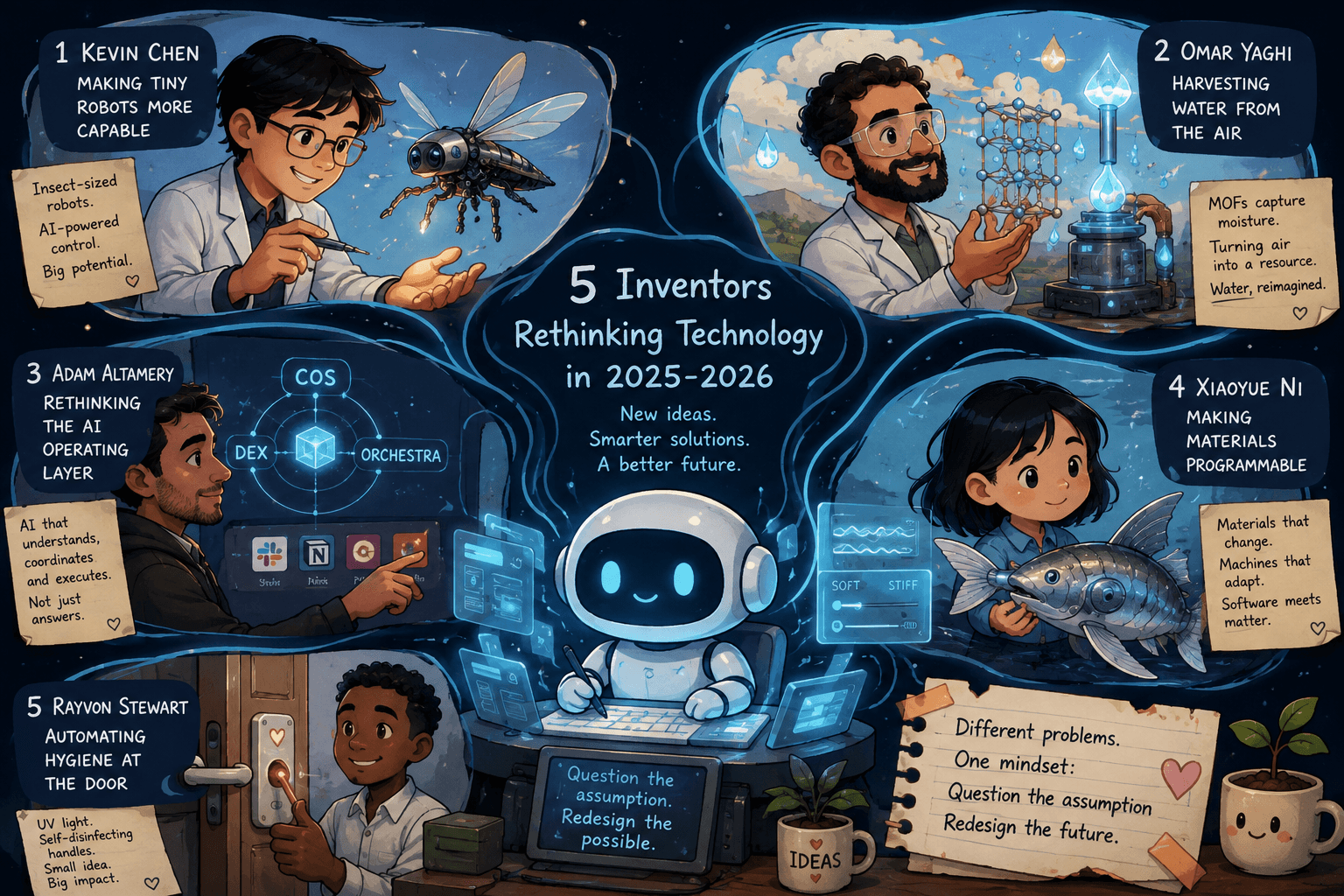
The most important lesson from today’s inventors is that meaningful innovation often begins by questioning existing assumptions. From insect-sized robots and atmospheric water harvesting to programmable materials and AI operating architectures, these technologies show that progress comes not only from improving systems, but from rethinking how those systems should work in the first place.
Some of the most interesting inventions of 2025 and 2026 are not simply better versions of existing products. They rethink how a problem is approached in the first place.
From insect-sized robots and atmospheric water harvesting to programmable materials and new AI architectures, these five inventors are working on very different problems but each is challenging an assumption about how technology should work.
1. Kevin Chen: Making Tiny Robots More Capable
Kevin Chen and his team at MIT are working on aerial robots roughly the size of an insect. In 2025, the researchers demonstrated a tiny flying robot capable of rapid, controlled maneuvers while weighing less than a paperclip.
The engineering challenge goes beyond making something small enough to fly. At that scale, conventional control approaches become difficult because the robot has very little room for hardware and must respond quickly to changing aerodynamic conditions.
Chen's team has explored AI-based control techniques to help these miniature machines perform more complex movements.
The interesting idea is that AI does not have to mean a large model or a conversational interface. In this case, machine learning becomes part of the control system itself—helping a machine operate within physical constraints that are difficult to model perfectly.
What if a water source did not have to be a river, reservoir or underground aquifer?
Chemist Omar Yaghi has spent years developing metal-organic frameworks (MOFs), materials with structures that can capture and interact with molecules in unusual ways. His work has helped establish the scientific foundation for systems designed to extract water from atmospheric moisture.
In 2026, Yaghi's company Atoco has been developing atmospheric water-harvesting technology using these materials, including systems intended to operate in relatively dry environments.
The broader engineering idea is fascinating: instead of treating a dry environment as a place where water cannot be obtained, change the mechanism and treat the moisture already present in the atmosphere as a potential resource.
3. Adam Altamery: Rethinking the AI Operating Layer
Most AI products today sit inside an existing software environment. You open an AI application, provide an instruction and receive an answer.
Adam Altamery, founder of COPYME AI and DEEPROOTS, is pursuing a different architectural question: what if AI itself became part of the operating layer?
COPYME AI has been developed over approximately 12 years around an architecture that aims to move beyond AI assistance toward coordinating and executing workflows.
Its architecture includes COS, DEX and Orchestra. Rather than treating AI as another isolated application, the broader concept is to create an intelligent layer capable of coordinating information, intelligence and execution across personal and enterprise workflows.
That is particularly interesting in a world where work is still fragmented across platforms such as Google, Microsoft, Slack and Notion. The problem is no longer simply whether AI can generate an answer; it is whether an AI system can understand a task and coordinate what needs to happen next.
COPYME AI is an attempt to approach that problem from the architecture upward rather than simply adding another AI feature to the existing stack.
4. Xiaoyue Ni: Making Materials Programmable
Software can change what a device does without physically rebuilding it. Materials have traditionally been much less flexible.
Xiaoyue Ni and researchers at Duke University are working on programmable materials that can alter characteristics such as stiffness and shape through digital control.
One demonstration used specially engineered metamaterials in a robotic fish. By changing the material's stiffness, researchers could alter how the robot moved, including its ability to turn and perform different maneuvers.
The significance goes beyond one robotic fish. If materials themselves can become dynamically controllable, future machines may not need to rely entirely on separate motors and rigid mechanical components to change their behavior.
5. Rayvon Stewart: Automating Hygiene at the Door
Some inventions are interesting precisely because they focus on something people normally ignore.
Jamaican inventor Rayvon Stewart developed Xermosol, a self-disinfecting door-handle concept designed to use ultraviolet light to disinfect the handle after use.
Stewart developed the idea after volunteering in a hospital and seeing the practical challenges surrounding frequently touched surfaces. The invention is intended as an additional layer of hygiene rather than a replacement for established cleaning procedures.
It is a relatively simple example of a broader engineering principle: sometimes automation becomes valuable not by replacing an entire system, but by improving one small point of friction that occurs repeatedly.
The Common Thread
These inventions have almost nothing in common on the surface.
One operates at insect scale. Another tries to extract water from the atmosphere. Another changes the properties of materials through digital control. Another applies automation to a door handle. And COPYME AI approaches AI as an operating architecture rather than simply another application.
But they share a useful engineering instinct: question the assumption underneath the problem.
The most interesting inventions are often not the ones that add another feature to an existing system. They are the ones that ask whether the system itself could work differently.
For developers and engineers, that may be the more useful lesson from the current wave of invention. Progress does not always come from making the existing architecture faster.
Sometimes it starts by asking whether you should be building on that architecture at all.


.jpeg&w=3840&q=75)