Get a summary of this article with your favorite AI:
A growing waiting list is usually seen as a capacity problem: too many patients and not enough appointments, clinicians, diagnostic capacity or treatment slots.
That is certainly part of the challenge. But capacity alone does not determine how efficiently patients move from referral to consultation, diagnosis and treatment.
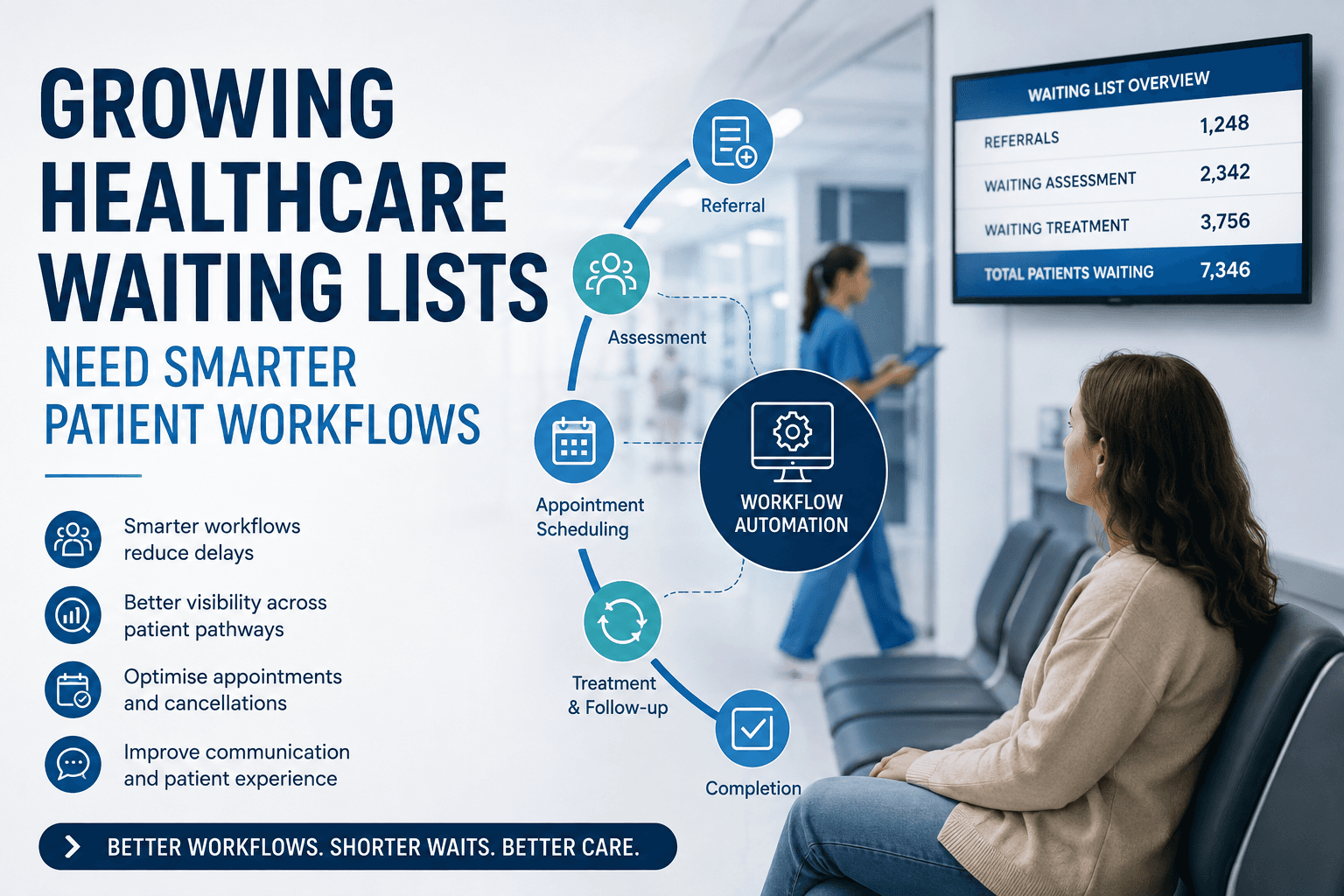
Every patient pathway also depends on a series of operational steps. Referrals need to reach the correct team. Information needs to be available when decisions are made. Appointments must be coordinated. Cancellations need to be managed. Follow-ups have to happen, and staff need to know which patients require the next action.
When these processes depend heavily on manual administration, fragmented information and repeated follow-ups, already stretched healthcare capacity becomes even harder to use effectively.
For UK healthcare organisations facing growing waiting lists, improving the workflows surrounding patient care can therefore be an important part of the response.
A Waiting List Is More Than a List of Patients
The term "waiting list" can make the challenge sound relatively simple: patients enter a queue and gradually move through it.
Real patient pathways are much more complicated.
A patient may be referred for specialist assessment before requiring diagnostics. Results may need reviewing before another appointment can be arranged. Further information may be required from another department. A cancellation might create an available slot that needs to be offered to an appropriate patient quickly.
Each stage creates another operational hand-off.
When those hand-offs are well coordinated, patients can move through the pathway more efficiently. When they are not, administrative friction can add avoidable delays.
This is where Healthcare Workflow Automation becomes relevant. It cannot create additional clinicians or treatment capacity, but it can help organisations make better use of the resources and capacity they already have.
Referral Management Can Become an Early Bottleneck
The patient journey often begins before the first hospital appointment.
A referral arrives and needs to be received, reviewed, categorised and directed appropriately. Missing information may need to be requested before the next step can take place.
Where much of this coordination is manual, administrative teams can spend significant time checking records, sending updates and moving information between systems.
Smarter workflows can automate appropriate parts of this process.
For example, a workflow can route a referral according to defined criteria, trigger a task when additional information is required and notify the appropriate team when action is outstanding.
Human judgement remains where it is needed. Automation handles more of the predictable administration around it.
Cancellations Should Not Automatically Become Lost Capacity
When demand is high, an unused appointment represents valuable capacity.
Yet responding effectively to cancellations requires more than knowing that a slot has become available. Staff need visibility of suitable patients, pathway requirements and outstanding actions before that capacity can be reassigned.
A connected workflow can trigger activity as soon as circumstances change rather than relying entirely on someone discovering the change and beginning a series of manual calls, emails or system checks.
That does not guarantee every cancelled slot will be filled.
It does, however, give operational teams a better opportunity to respond quickly and use available capacity effectively.
Staff Should Not Have to Search for the Next Action
Another challenge appears when information about a patient's pathway exists across several applications or departments.
A team may know that a patient is waiting, but not immediately know why.
Is an assessment outstanding?
Are test results awaited?
Does another department need to take action?
Has an appointment been scheduled?
Is additional information required?
When staff have to search across systems or contact colleagues to answer these questions, managing a large waiting list becomes increasingly difficult.
Better Healthcare Workflow Visibility can provide operational teams with a clearer picture of pathway status, ownership and outstanding actions.
Rather than simply showing how many patients are waiting, healthcare organisations can gain better insight into where patients are within a process and what needs to happen next.
Connected Patient Workflows Can Reduce Administrative Friction
The objective should not be to create another standalone system for staff to manage.
Instead, organisations can connect appropriate processes around the technologies they already use.
This is one area where Dynamics 365 for Healthcare can support a broader digital strategy.
Combined with Microsoft Power Platform and appropriate integrations, Dynamics 365 can help healthcare organisations coordinate operational information, automate repetitive tasks and create more structured workflows around patient and administrative processes.
For example, automation could support:
referral and request routing;
outstanding-action notifications;
appointment-related administrative workflows;
follow-up tasks;
escalation of overdue activities;
coordination between operational teams; and
visibility of workflow status and exceptions.
The purpose is not to automate clinical decision-making. It is to remove unnecessary administrative friction surrounding the decisions healthcare professionals need to make.
Better Visibility Helps Teams Prioritise
Large waiting lists also create a management challenge.
Knowing the total number of patients waiting is important, but operational teams need more actionable information.
They need to understand where bottlenecks are developing, which processes repeatedly stall, where actions are overdue and whether administrative issues are preventing patients from progressing.
This is why improving healthcare workflow visibility with Dynamics 365 can be valuable beyond basic reporting.
Visibility should help teams act.
If a dashboard shows that a particular workflow stage repeatedly accumulates outstanding cases, managers can investigate the underlying process. If an activity has exceeded an expected timeframe, an automated escalation can bring it to the appropriate person's attention.
That turns operational data into action rather than another report to review.
Patient Communication Is Part of the Workflow Too
Waiting can become more frustrating when patients do not know what is happening next.
Healthcare teams also spend significant administrative time responding to requests for updates.
Structured communication workflows can help organisations send appropriate confirmations, reminders and status communications at defined stages of the patient journey.
A modern Healthcare CRM approach can also help maintain a more consistent record of relevant interactions while supporting communication across teams.
Again, automation should complement human communication rather than replace it. Complex, sensitive or clinical conversations still require people.
Routine updates should not always require someone to initiate them manually.
Start With the Bottleneck, Not the Technology
A hospital does not need to automate an entire patient pathway at once.
A more practical approach is to identify where avoidable friction is having the greatest impact.
Perhaps referrals regularly require manual re-routing.
Perhaps cancellations are difficult to refill.
Perhaps staff spend too much time identifying outstanding actions.
Perhaps managers cannot easily see why patients are not progressing.
Once the bottleneck is understood, organisations can decide whether process redesign, Healthcare Workflow Automation, better integration or another intervention is appropriate.
This also prevents Healthcare Digital Transformation from becoming a technology-first exercise.
The objective isn't to implement more software.
The objective is to help patients move through appropriate administrative stages with fewer unnecessary delays.
Smarter Workflows Will Not Solve the Capacity Challenge — But They Can Help
The pressures behind growing healthcare waiting lists are complex. Workforce availability, clinical capacity, demand, infrastructure and funding cannot be fixed by workflow automation.
Technology should not be presented as though it can.
But healthcare organisations can still ask an important question:
Are avoidable administrative bottlenecks making an already difficult capacity problem worse?
If the answer is yes, smarter patient workflows deserve attention.
By reducing repetitive administration, improving coordination, providing clearer workflow visibility and helping teams respond faster when action is required, healthcare organisations can make better use of the capacity they have.
For UK healthcare providers facing sustained waiting-list pressure, that distinction matters.
Workflow automation cannot create more hospital capacity. But it can help prevent valuable capacity from being lost to inefficient processes.