
Get a summary of this article with your favorite AI:
Somewhere in the last eighteen months, a quiet swap happened. Your buyers stopped asking Google and started asking ChatGPT, Perplexity, and Gemini. Google itself now answers most questions before anyone clicks anything. And the content strategy your team is still running — rank for keywords, win the click — is optimizing for a game that's winding down.
The numbers are hard to argue with. Roughly 68% of US Google searches now end without a single click SparkToro. When an AI Overview appears on a results page, click-through drops to about 8%, versus 15% without one — and only around 1% of people click the source links inside the AI summary itself Pew Research, 2025. Meanwhile ChatGPT alone crossed 900 million weekly users.
So here's the uncomfortable question for every founder who signed off on a content budget this year: if the AI gives the answer, why does your content exist?
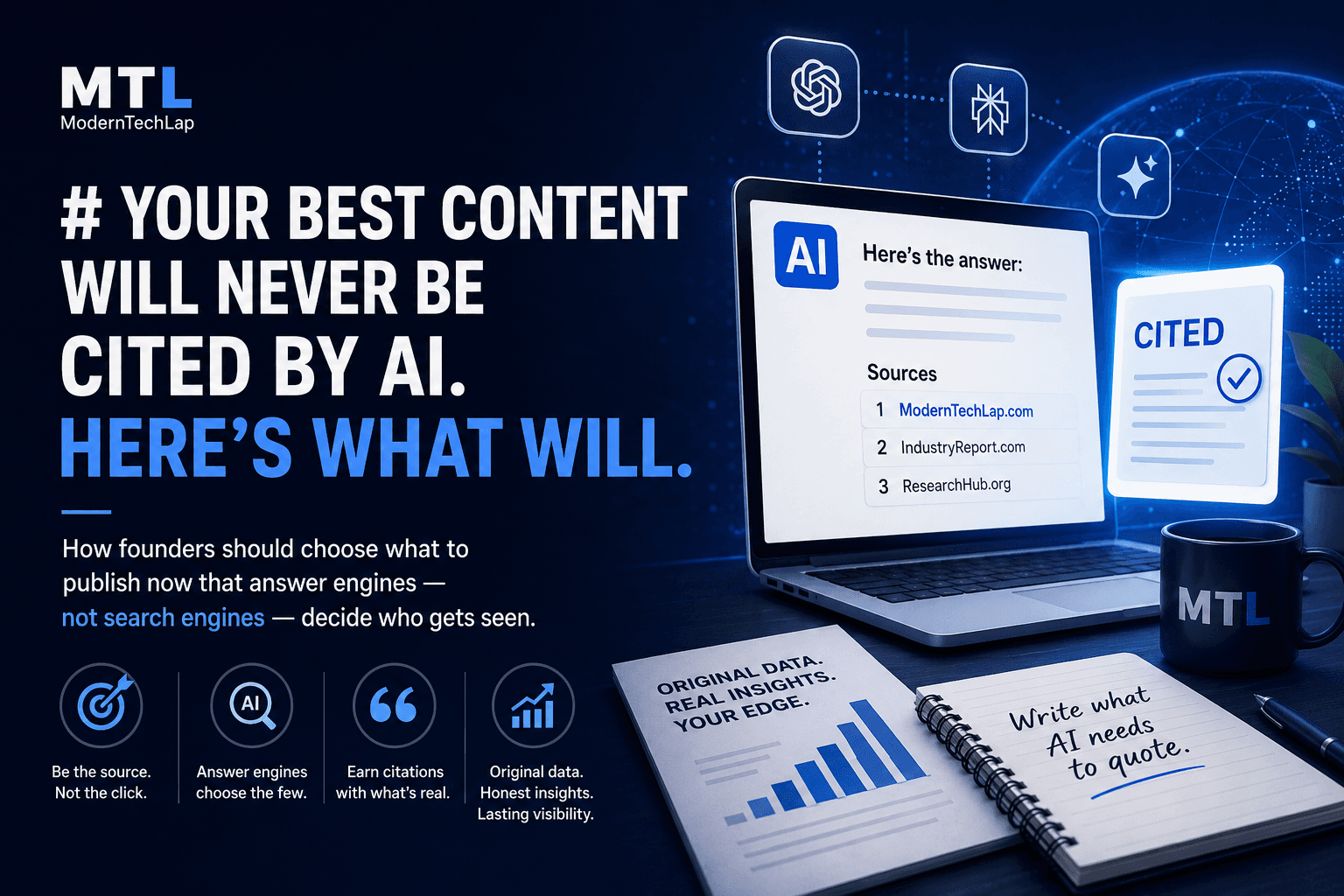
The answer is that it exists to be cited — to be the source the machine names when it explains your category to your buyer. That's the new distribution. And the single biggest lever isn't how you write. It's what you choose to write about in the first place.
Most GEO advice skips this. It jumps straight to schema markup and FAQ blocks — the formatting layer. Formatting matters, but formatting a topic that AI engines will never cite is polishing a page nobody's model will ever pull. Topic selection comes first. Here's how to get it right.
First, understand what you're actually competing for
Traditional SEO was a ranking contest: ten blue links, and position one took the spoils. AI citation is a sourcing contest. When an answer engine composes a response, it retrieves a handful of passages from across the web, synthesizes them, and credits a few sources. Your goal is to be in that handful.
Two findings should reframe how you think about this:
Rankings and citations are different games. Ahrefs found only a ~7% overlap between what ChatGPT cites and Google's top-10 results, and BrightEdge data suggests the large majority of AI citations come from pages outside the organic top ten. A page that never cracked page one of Google can be the most-cited source in your category — if it's the kind of page these systems want.
We know what these systems want. The Princeton/Georgia Tech GEO study — the paper that coined the term — tested it directly: adding relevant statistics, expert quotations, and clear source citations improved a page's visibility in AI-generated answers by roughly 30–40%. Answer engines are, in a sense, lazy researchers on a deadline. They reach for the page that has already done the work: the number, the definition, the comparison, the named expert.
Read those two findings together and the strategy writes itself. Stop asking "what can we rank for?" Start asking "**what would an AI need to quote us on?**"
The four content types that actually earn citations
After running GEO audits across real estate, healthcare, and travel businesses, I keep seeing the same pattern: citations cluster around four content types. Almost everything else is invisible.
1. Content that contains a number nobody else has
AI engines love statistics because statistics are quotable, verifiable-looking, and hard to paraphrase away — you can reword an opinion, but "43% of mid-market SaaS deals now involve an AI evaluation step" has to be attributed to someone. If that someone is you, you're in the answer.
You don't need a research department. You need proprietary observation. A 40-person agency has data on hundreds of client engagements. A SaaS founder has anonymized usage patterns. A staffing firm knows real placement timelines and salary bands. Package one honest, specific finding per quarter — a short report, a single chart, a stated methodology — and you've created the citation magnet that a hundred generic blog posts can't match.
The topic-selection question here: what do we know, from our own operations, that the internet currently has no number for?
2. Content that defines something before consensus forms
Answer engines need definitions constantly — "what is X," "X vs Y," "how does X work" queries are their bread and butter. For established terms, Wikipedia and the incumbents win. But every industry has a rolling frontier of terms that are six to eighteen months old and still poorly defined. That frontier is where a smaller brand can become the definitional source, because the models have thin training data and their retrieval finds few credible pages.
Two years ago, "generative engine optimization" was that kind of term. The handful of sites that defined it early are still harvesting citations today. Your industry has its equivalents right now. The question to ask in your next content meeting: what is everyone in our space suddenly saying that nobody has properly written down?
3. Content that makes an honest comparison — including against yourself
"Best X for Y" and "X alternatives" queries are among the most commercially valuable prompts people type into AI assistants, and the engines resolve them by finding comparison content. Here's the counterintuitive part: a comparison page that fairly includes your competitors — real pricing, real trade-offs, cases where a rival is the better fit — gets cited far more than a thinly disguised sales page, because it reads like the neutral source the model is looking for.
Most founders can't stomach naming competitors on their own domain. That reluctance is precisely why the tactic still works.
### 4. Content that answers the question your sales team hears every week
Your sales calls are a transcript of your market's actual questions, phrased the way real buyers phrase them — which is increasingly the way they phrase prompts. "Can we integrate this with our existing EHR?" "What does implementation actually take?" "Why is your quote 30% higher than the offshore one?" Each recurring question is a page: the question as the heading, a direct 40–60 word answer up top, depth below. This is the cheapest citation inventory you own, and most companies leave it sitting in call recordings.
## What to stop writing
Choosing the right content also means killing the wrong content, because it drains the budget that should fund the four types above. Three candidates for the axe:
Generic thought leadership. "Why digital transformation matters" has ten thousand interchangeable versions. An answer engine can synthesize that take without citing anyone — so it does.
Volume-play keyword posts. The 800-word posts targeting long-tail keywords made sense when each ranking earned clicks. In an answer economy, twenty shallow pages lose to one deep page with original data. Consolidate them.
Anything your buyer's AI can generate itself. Before greenlighting a piece, run the brutal test: paste the working title into ChatGPT. If it produces a passable version from general knowledge, the topic adds nothing to the training-and-retrieval pool, and no engine needs to cite you for it. Publish only what the model couldn't say without you.
A 30-minute filter for your next content meeting
Score every proposed topic from 0–2 on five questions, and fund only what clears 7:
1. Uniqueness — does this contain a fact, number, or firsthand observation that exists nowhere else?
2. Quotability — is there a sentence an AI could lift verbatim, with a clear claim and a clear source?
3. Question-fit — does it map to a question real buyers actually ask an assistant?
4. Authority-fit — do we have legitimate standing to be the source on this, or are we tourists?
5. Durability — will this still be retrieval-worthy in twelve months?
It's a simple instrument, but it reliably kills the me-too posts and surfaces the citable ones — and it forces the conversation most content teams avoid: what do we uniquely know?
The mindset shift underneath all of this
For twenty years, content marketing meant intercepting attention: be present when someone searches, win the click, convert the visit. AEO and GEO quietly invert the model. You are no longer writing for a reader who clicks. You are writing for a machine that reads everything and vouches selectively — and for the buyer who trusts its vouching.
That machine has, in effect, editorial standards: original data over recycled takes, direct answers over throat-clearing, named sources over vague claims, honest comparisons over brochures. Notice something? Those were always the standards of good publishing. The AI era doesn't reward a trick. It rewards being the kind of source a careful human editor would have cited all along — and it punishes, with total invisibility, the content that was only ever engineered for an algorithm.
Choose your next ten topics like a publication, not like a keyword tool. That's the whole strategy.