
Get a summary of this article with your favorite AI:
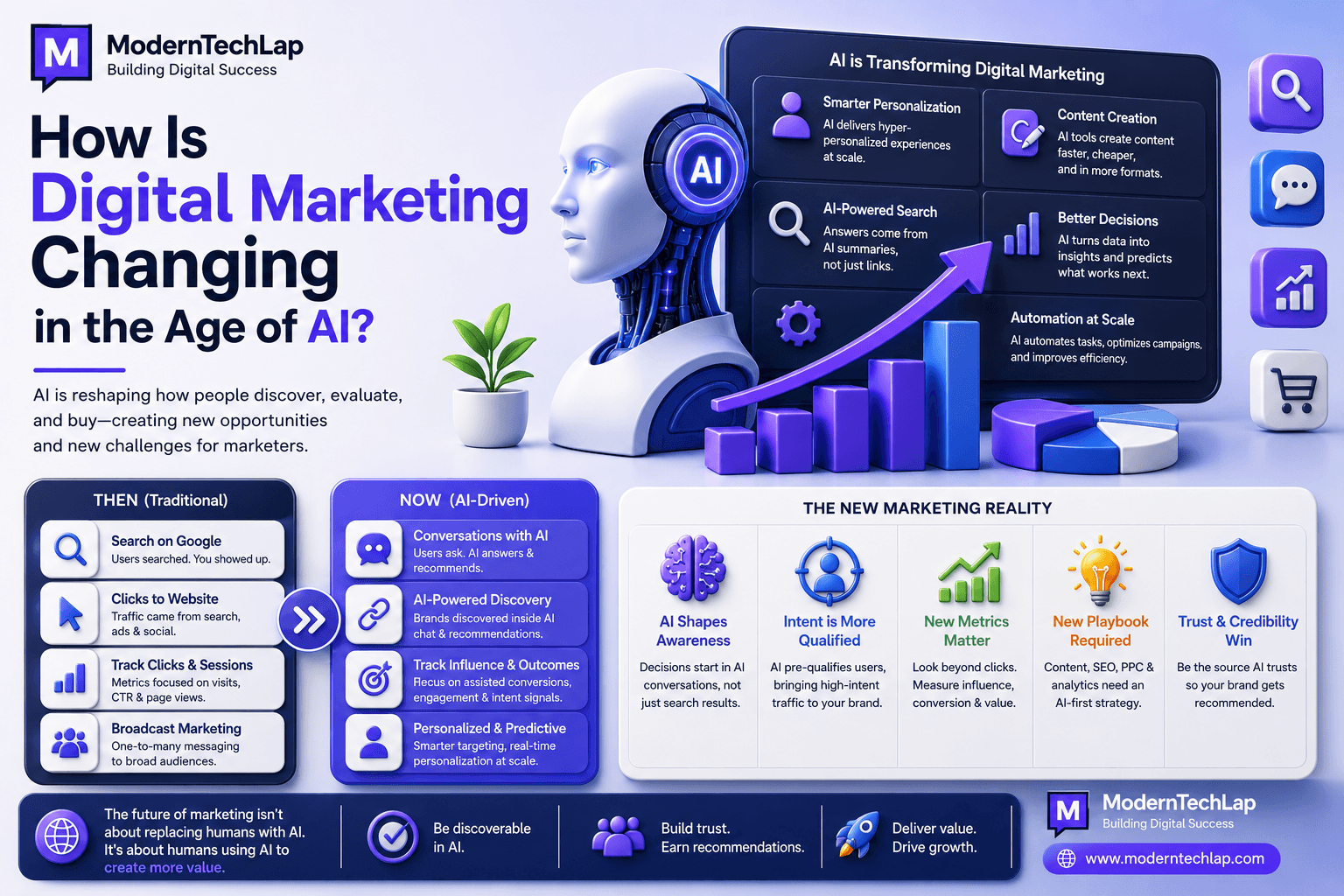
Digital marketing isn't being disrupted by AI the way most trend pieces describe it. It's being split in two. One half of the discipline (paid media, personalization, content production) is getting faster and cheaper because of AI tools. The other half (search visibility, attribution, the basic question of where your customers actually come from) is getting harder to see clearly, because AI is sitting between your brand and the customer in a way it wasn't two years ago.
Most of what gets written about "AI and marketing" collapses those two things into one story. I want to keep them separate, because the decisions you make in response are different for each.
What's actually different about digital marketing right now, versus five years ago?
The biggest structural change isn't a new channel. It's that a growing share of research and buying decisions now happen inside an AI conversation instead of on a results page or a website, which means the customer can form a preference before your brand ever gets a click.
That's a different problem than "add AI tools to your stack." Tools change your workflow. This changes where the moment of influence actually happens, and in a lot of categories, marketing teams don't have visibility into that moment yet because their analytics were built to measure clicks, not conversations.
How is Google's AI Overviews feature changing organic search traffic?
It's compressing clicks on informational queries while making the clicks that remain more valuable, and the size of that effect depends heavily on which study you read and which quarter it covers.
Pew Research Center's study found that when an AI Overview appears on a Google search, users click through to a traditional organic result only about 8% of the time, compared to roughly 15% of the time when no AI Overview is shown. Seer Interactive tracked this at a larger scale: across 53 brands, 5.47 million queries, and 2.43 billion impressions from January 2025 through February 2026, organic click-through rate on AI Overview queries fell from 1.76% to a low of 0.61% before partially recovering to 2.4% by February 2026. Worth sitting with both halves of that number. It's a real recovery. It's also still well below the 3.8% CTR that queries without an AI Overview were getting over the same period, so the gap between "AI-summarized" and "not AI-summarized" search results hasn't closed, it's just stopped widening as fast.
Here's the caveat nobody likes putting in these posts: study results vary a lot depending on methodology, industry, and time window. Ahrefs, Seer, and Pew all measured different things in different ways, and the honest takeaway is directional, not a single precise number you can plug into a forecast. What's consistent across every study is the direction: fewer people click through when an AI Overview answers the question directly on the page.
Are people actually researching and buying through ChatGPT now, or is that overstated?
Yes, and it's growing faster than almost any other referral channel retailers track, though it's still small relative to total search volume.
Adobe Analytics, tracking more than one trillion visits across U.S. retail sites, found AI-referred traffic to retailers grew 393% year over year in the first quarter of 2026. PYMNTS reported that ChatGPT's share as a product research tool climbed from about 2% to 30% over two years, enough to push Amazon from the second most-used product research platform down to third (Google remains first). And the traffic isn't just growing, it's converting better than it used to: Adobe found AI-referred traffic converted 42% better than non-AI traffic in March 2026, a reversal from converting 38% worse than non-AI traffic just a year earlier.
Why the flip? The behavioral explanation, per Shopify's own reporting on this, is that a shopper who lands on your site from ChatGPT has usually already had the AI narrow down and compare options before they ever click a link. Someone Googling "standing desk under $800" is still browsing. Someone who asked ChatGPT the same question and clicked through has already been filtered. That's a genuinely different kind of visitor, and it's part of why more than half of AI-referred Shopify sessions land directly on a product page instead of a homepage or category page.
None of this means ChatGPT is bigger than Google. It isn't, not close. It means the earliest, most decision-shaping part of the customer journey is starting to happen somewhere your analytics dashboard doesn't show you.
How much are marketing teams actually spending on AI, and is it working?
CMOs are putting real budget behind AI, but Gartner's own data shows most of them admit they aren't ready to use it well yet, which is a more honest answer than most vendor content gives you.
Gartner's 2026 CMO Spend Survey, fielded January through March 2026 across 401 CMOs and marketing leaders, found that organizations are allocating an average of 15.3% of marketing budgets to AI initiatives. Seventy percent say becoming an AI leader is a critical goal for 2026. And in the same survey, 70% also admit their internal marketing processes aren't mature enough to actually scale AI effectively. Only 30% report mature AI readiness. The CMOs who do have that maturity aren't spending marginally more, either: they allocate 21.3% of budget to AI versus the 15.3% average, and they run marketing budgets averaging 8.9% of company revenue versus roughly 7.8% for everyone else.
There's a quieter number in the same survey worth flagging: martech's share of the total marketing budget has fallen to a five-year low of 19.4%, down from 26.6% in 2021, even as 62% of CMOs plan to increase martech investment. Budgets are shifting toward usage-based tools and AI capability rather than the flat-license software stack marketing teams built up over the last decade. If your team's tool budget hasn't moved in that direction, that's worth a direct look, not because AI spend is inherently good, but because the survey data suggests the rest of the market is restructuring how it buys software, and legacy licensing terms may quietly be costing you.
What does "SEO" even mean now that AI answer engines are in the picture?
SEO used to mean optimizing to rank in a list of ten blue links. It increasingly means optimizing to be the source an AI system chooses to cite, summarize, or recommend, which is a related but genuinely different skill, usually grouped under the terms AEO (answer engine optimization) and GEO (generative engine optimization).
The practical differences that actually matter:
Structure over keyword density. AI systems extract answers more easily from content with clear direct-answer paragraphs, tables, and specific claims than from keyword-optimized prose built for ranking algorithms.
Citation behavior is selective, not comprehensive. Reporting on ChatGPT's retrieval behavior found it evaluates far more pages than it actually cites, meaning most of what a system reads never gets surfaced to the user. Being findable isn't the same as being cited.
Original, checkable claims travel further than synthesis. Content that restates what's already published elsewhere gives an AI system nothing new to attribute to you specifically.
Structured data is doing more work than it used to. Product and content pages using structured markup are more likely to appear as sources in AI-generated answers, since agents and AI systems rely on machine-readable data the way earlier search crawlers relied on plain text.
None of this replaces traditional SEO. It sits alongside it. A page that ranks well and gets cited by AI Overviews is still better off than one that only does one or the other.
Where are marketing teams getting this wrong?
The most common mistake I see isn't ignoring AI. It's treating "adopt AI" as a checklist item disconnected from the actual funnel problem it's supposed to solve. Gartner's own readiness gap, 70% calling AI leadership a critical goal while 70% admit their processes aren't mature enough to scale it, is basically a survey-level confirmation of that pattern. Teams are buying tools and running pilots faster than they're rebuilding the underlying process, measurement, and skills those tools actually require to pay off.
The second mistake is measurement. If your attribution model only counts a session as "AI-influenced" when it lands with a clean UTM tag from a chatbot, you're almost certainly undercounting it. A meaningful share of AI-referral sessions get misclassified as direct traffic in standard analytics setups, because the referring domain data AI platforms pass along is inconsistent. That means the channel showing the strongest growth in your industry might be sitting inside a bucket your dashboard already labels as something else.
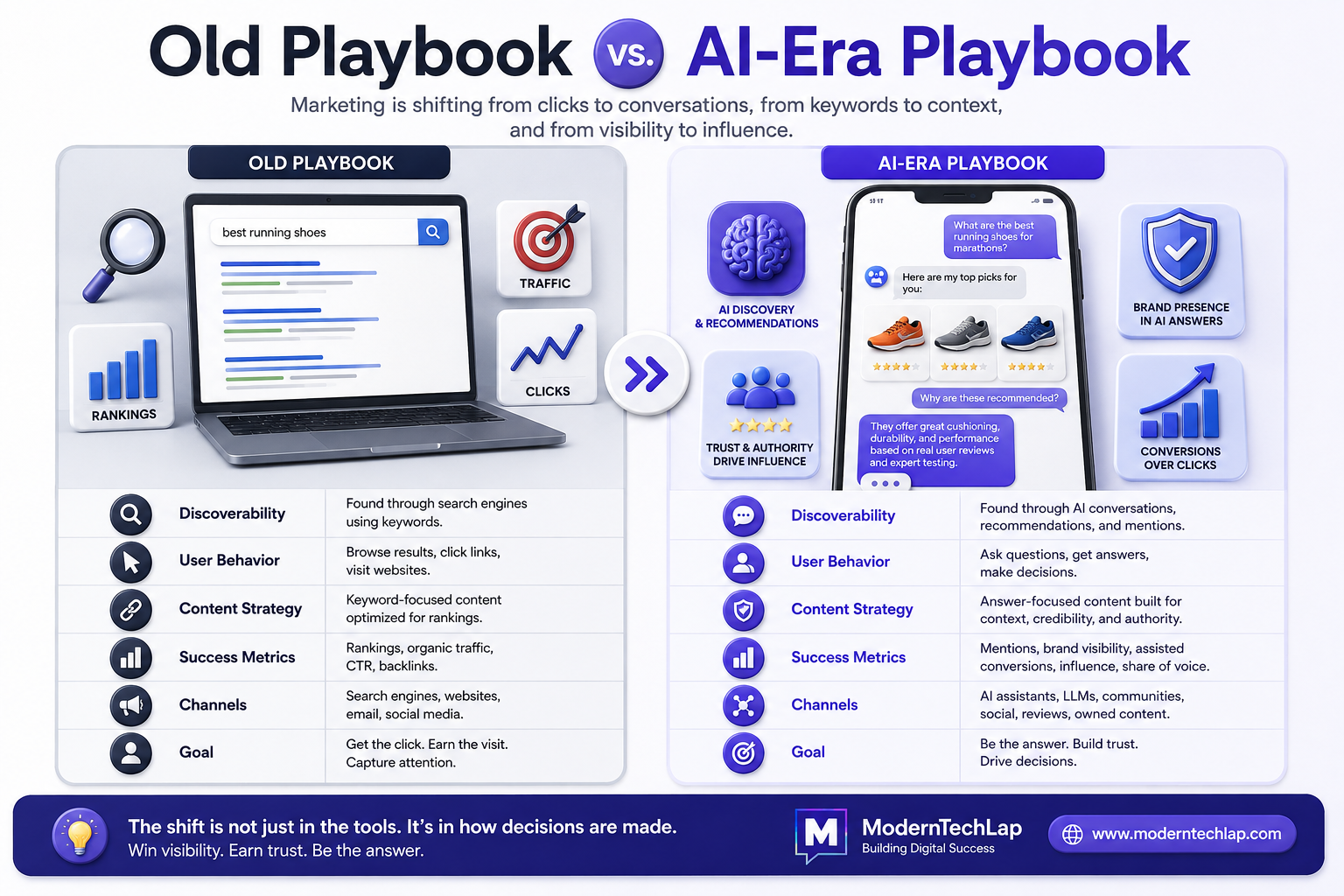
Old playbook versus AI-era playbook
FAQ
Is Google losing traffic to ChatGPT?
Not in aggregate. Google remains the dominant product research and search platform by a wide margin. What's changing is that ChatGPT has grown fast enough to displace Amazon as the second most-used product research tool in at least one industry survey, and AI Overviews are changing how much traffic organic results generate even when Google stays the entry point.
Do I need to abandon traditional SEO for AEO and GEO?
No. Ranking in traditional organic results and getting cited in AI-generated answers are separate, overlapping goals. Structured, direct-answer content tends to help with both.
How much of my marketing budget should go to AI tools?
There's no universal number, but Gartner's 2026 survey found the average CMO allocates 15.3% of budget to AI, with the most AI-mature organizations at 21.3%. Match the investment to actual process readiness, not the average, since the same survey found most organizations aren't yet equipped to scale what they're buying.
Why does my analytics dashboard show almost no AI-referred traffic?
Standard analytics setups often misclassify AI-referral sessions as direct traffic because chatbot platforms don't always pass consistent referring-domain data. If a competitor or industry report shows meaningful AI referral growth and your dashboard shows none, check how direct traffic is being attributed before assuming you're not getting any.
Does AI-referred traffic actually convert better than regular search traffic?
Recent data says yes, though it's a recent reversal. Adobe Analytics found AI-referred retail traffic converted 42% better than non-AI traffic in March 2026, compared to converting worse than non-AI traffic a year earlier. That's a fast-moving trend, worth rechecking quarterly rather than treating as settled.
What's the single most useful change to make first?
Fix measurement before you fix strategy. Most teams are making channel decisions based on attribution data that's already undercounting the fastest-growing part of their funnel. Get that visible first.
A note on scope: the traffic, budget, and conversion figures here are moving fast, several changed direction within the twelve months covered by this piece, so treat anything with a specific percentage as needing a recheck every quarter, not as a fixed fact. The structural argument (AI sitting earlier in the customer journey, measurement lagging behind it) is the more durable takeaway.
Sources
Search Engine Land: Google AI Overviews CTR shows early signs of recovery
Gartner: 2026 CMO Spend Survey
Gartner: Awareness and Conversion Account for 62.6% of Total Media Spend
PYMNTS: Retail's Best Customer Now Arrives From ChatGPT
Chief Marketer: Gartner CMO Spend Survey on martech budget share
.jpeg&w=3840&q=75)