Get a summary of this article with your favorite AI:
Quick answer
Visible messaging apps can expose private conversations through lock screen notifications, shared devices, and app visibility. While encryption protects messages during transmission, privacy also depends on controlling how conversations appear in everyday situations. Modern privacy-focused messaging solutions are increasingly combining security with discretion to help users maintain greater control over personal communications.
Here's the rewritten version — same structure and message, with the disguised-app pitch dropped in favor of genuine, actionable privacy practices.
The Hidden Risks of Visible Messaging Apps
Messaging applications have become an essential part of daily communication. Whether for personal conversations, family discussions, professional coordination, or sharing important information, messaging apps play a central role in how people connect.
Over the years, significant attention has been given to securing digital communication through technologies such as end-to-end encryption. While these advancements have improved message security, many users overlook another important aspect of privacy: visibility.
A conversation can be secure from interception and still become visible to unintended people in everyday situations. In many cases, privacy risks don't come from sophisticated cyberattacks but from ordinary interactions involving shared devices, notifications, and app visibility.
As digital communication continues to evolve, understanding the hidden risks of visible messaging apps is becoming increasingly important.
Privacy Challenges Beyond Encryption
Encryption protects messages while they travel between devices, ensuring that only the intended participants can read the content of a conversation.
But encryption alone can't prevent private information from being exposed on a user's device itself.
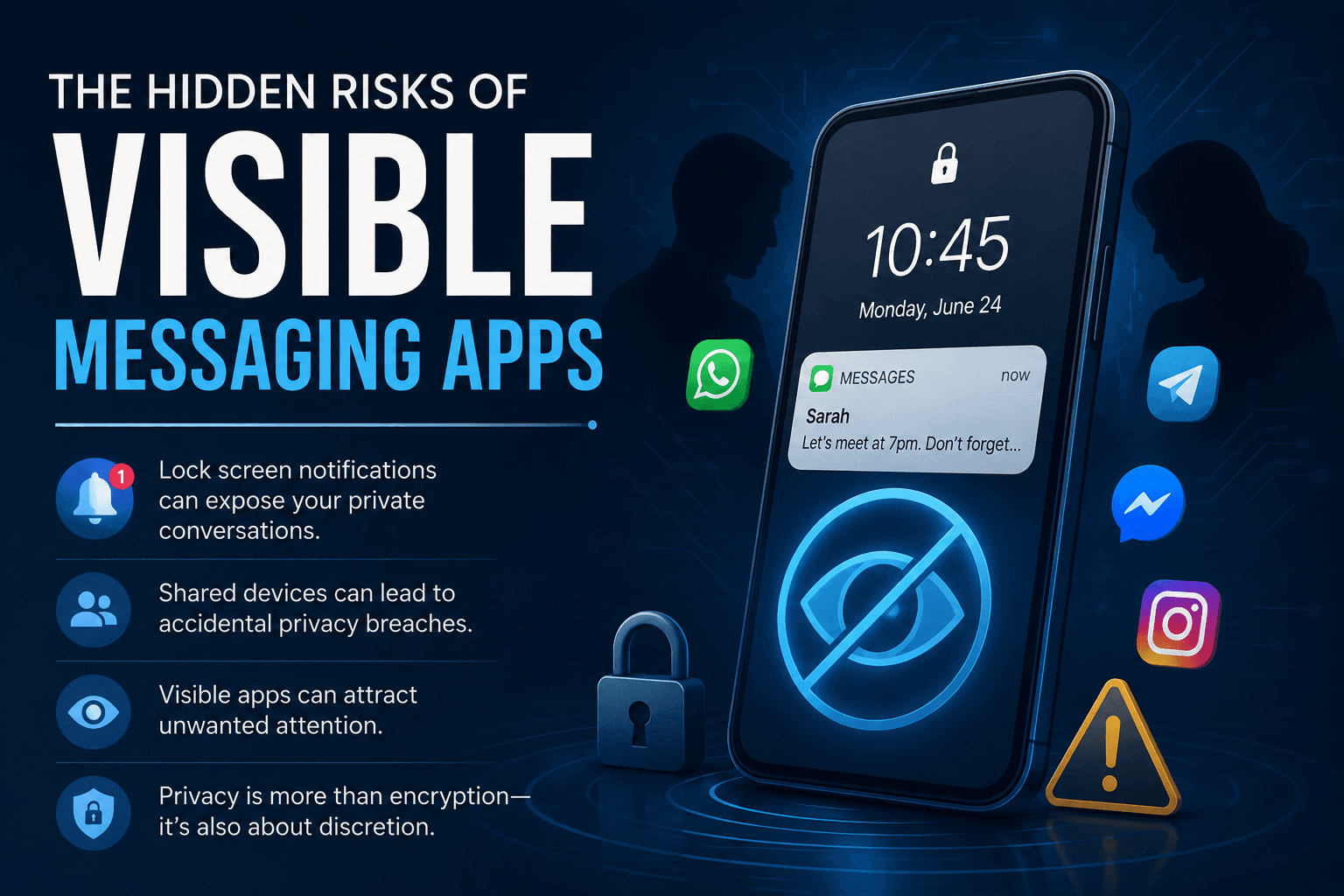
A message preview on a lock screen can reveal personal information before a phone is even unlocked. A messaging app icon sitting on the home screen can quietly signal that private conversations are happening. These situations show that privacy isn't only about securing data in transit — it's also about controlling how conversations appear and who can access them in everyday environments.
One of the most common privacy risks comes from lock screen notifications.
Many messaging apps display message previews, sender names, and snippets of conversations directly on the lock screen. While convenient, these previews can expose information to anyone who happens to glance at the device — at work, at home, while traveling, or in social settings.
Even people who are otherwise careful about digital security often underestimate how much can leak through notifications alone.
Shared Devices and Casual Access
Another challenge arises when devices are shared with family members, friends, or colleagues.
People frequently hand their phones to others for simple tasks: making a call, looking at photos, using a calculator, searching for something online, or pulling up a document. During these moments, messaging apps may be visible on the home screen, in the recent-apps list, or through the notification panel.
The person borrowing the device may have no intention of looking at private conversations, but the visibility of messaging apps still creates unnecessary exposure.
App Visibility Can Attract Attention
Most messaging apps are designed to be easily accessible, with icons displayed prominently on the home screen, app drawer, or recent apps list. That convenience comes at a cost: it can also make private conversations more noticeable.
A visible messaging app signals that conversations are taking place, even when the content itself stays secure. For people who value discretion, this visibility raises concerns that encryption alone doesn't address.
Why Discretion Matters
Privacy and security are often discussed together, but they're different concepts.
Security focuses on protecting information from unauthorized access. Discretion focuses on reducing unnecessary attention to private information.
In practical terms, discretion is about controlling how visible conversations are in everyday situations — independent of how well-encrypted they are.
How Messaging Apps Are Evolving
As awareness of these risks grows, many messaging platforms have started building in tools that give users more control over visibility, not just security. Common features now include:
Customizable notification settings — hiding sender names and message content from lock screen previews, or muting previews entirely for specific chats
App lock and biometric authentication — requiring a PIN, fingerprint, or face scan before a chat app will open, even if the phone itself is unlocked
Disappearing and self-deleting messages — reducing how long sensitive content sits visible in a chat history
Screenshot and screen-recording alerts — notifying users if a conversation is captured
Separate or hidden chat folders — within mainstream apps, allowing certain conversations to require an extra step to access
These features let people keep the convenience of popular apps while reducing how much sensitive content is exposed during casual, everyday device use.
Building Better Privacy Habits
Technology helps, but habits matter just as much:
Disable message previews on lock screens.
Review notification settings regularly, especially after app updates.
Use strong device authentication (a real PIN or biometric lock, not a swipe).
Limit unnecessary app permissions that could expose data elsewhere.
Be mindful when handing your device to someone else, even briefly.
Check whether your messaging app offers app-locking or chat-hiding features, and turn them on.
Conclusion
Messaging security has improved significantly over the last decade, but privacy challenges continue to evolve. Visible messaging apps, lock screen notifications, shared devices, and app visibility can all create opportunities for unintended exposure. Encryption remains essential, but it's only one part of a broader privacy strategy.
As people become more aware of these everyday risks, the smartest approach combines strong encryption with deliberate notification settings, device-level authentication, and good habits around shared devices — giving users real control over both the security and the visibility of their personal conversations.



.jpeg&w=3840&q=75)